Omar (may Allah be pleased with him) series on youtube

Assalamu alaikum (Peace be unto you!)

I wanted to draw your attention to this series produced during the month of Ramadan of this year,1433 by the Islamic calendar. Unlike the Gregorian, the Islamic calendar begins its count with the ‘hijra’ or migration of the prophet (peace and blessing of God be upon him) and his small band of loyal followers, who are called the ‘sahaba’ meaning ‘companions’, from Mecca to Medina. It was a great thing to do, and I am sure even nowadays with skype, and phones and airplanes and what have you, when it is so easy to stay in touch, even now to migrate or immigrate is a big deal for people. It is a rebirth in a sense, a rejuvenation, a process that forces one to examine all one’s beliefs, mannerisms, culture and way of life whether one wants to or not. So the prophet may God elevate his beautiful soul, left his beloved hometown, the city that had persecuted and mocked himself, his message and his small number of followers for 13 years…where he had endured great torture and the first Martyr of Islam was made as well as its first follower; both women mind you (the former is Sumayya, freed African slave woman and the later Khadija the great, the prophet’s beloved wife and mentor, may God be pleased with them both), yet where his heart always would call home. He left to go to Medina and there welcomed with open arms, a nation-state was born. One of the first things he did when he settled in to Medina was to draw up a constitution for the governing of the city, remarkable. But I am digressing. So this was produced in 1433 hijri or 2012 by the gregorian calendar(!), a few short months ago, and with thanks to the producers that it is already up on youtube with English subtitles.

The series is about Umar, one of the prophet’s (peace be upon him) closest companions who at one time, wanted to kill him! He outlived the prophet (peace be upon him) by many years, and he lead the Muslim nation for much of that time. He died as he wished to die, martyred… it was also the first of many assassinations of the state’s head, the Muslim nation was to face. It is in 30 parts and I will post the first one below. You can youtube them all. It is a vast period in history to cover in 30 episodes and there is much to be commented on. But I don’t personally prefer to critique what is obviously a massive amount of work, except to say thanks for taking it on, thanks for the effort to make it as best as possible, and thanks for sharing it. So while there may be much to be improved upon, and much that has been left out or needs working on, it is a remarkable production and one of the most accurate ones out there in my amateur opinion.

I don’t want to go on too long. By watching it you will learn much about what this message is all about. It is actually nothing new. Only a renewal of messages before and a pointing toward a deeper examination of the meaning of existence, where we came from and where we are going. I learned about the importance of integrity, of being ‘upright watching it, and it reminded me of the hadith;

There is an important hadith (narration). A sound and authentic narration in which when the prophet was asked to say something only he could understand about Islam he said the below

On the authority of Abu ’Amr — and he is also called Abu ’Amrah — Sufyan bin Abdullah ath- Thaqafee(ra) who said:
I said, ‘O Messenger of Allah, tell me something about al-Islam which I can ask of no one but you.

He (peace and blessing of God be upon him) said,
Say I believe in Allah — and then be Steadfast (the arabic word is Mustaqim, translated as being upright, righteous, a person of integrity and sound morality and patient etc.)

[Bukhari]

I wonder why we Muslims complicate things so much. We are so worried about the external we have forgotten all about what this way of life is meant to teach and refine. It is meant to build character, keep us honest, people of truthfulness (yes, even if to our own detriment as the famous verse in the Quran enjoins) and self-awareness, people of joy and balance. All our ibadaath (acts of worship) are meant to train the soul, but we mask our soul from ourselves in all the clutter and noise. We cannot hear the voice of God, we are too busy trying to find the best way to listen! So watching this series was educational, for it reminded what it was all about, just being true to what one believes in, standing up for justice and for peace. For my non-Muslim brothers and sisters who stumble upon here or visit, I think it will be educational as well, for at least it will help to dispel all this nonsense myths circulating about Islam and Muslims (and by no means am I denying the Muslim nation has its share of rotten apples, as do all groups of people, but indeed the disgusting ones among the Muslims or so called Muslims do seem particularly evil. To clarify, those comments are as my mind goes to the Taliban when writing this, so no one misunderstands me. What is interesting is this same type so called ‘muslims’ existed even in the time of Ali, the great caliph! Some day I must blog about that episode. Human history has much to teach indeed).

To end, Muslims have given Umar the title of ‘Farook’ roughly meaning the one able to rightly judge, the one upon a true criterion. He was a strict and strong man. A lover of poetry. There is much to learn from his amazing life.

Enjoy the series. In keeping with Muslim etiquette, no image or voice from the prophet or his closest family is shown.

And to my Muslim brothers and sisters, Eid-ul-Adha Mubarak!

And to all, I leave you with the farewell of peace

Assalamu alaikum

BTW to watch the entire series, just youtube ‘MBC1 Omarseries English Subtitles’
Azaan – calling to prayer

Assalamu alaikum warahmatullah,

The recent global events and events in my own life and in that of my circle of brothers and sisters, whether known ‘virtually’ or ‘in-person’ (Sendie, here’s a call out to you, I hope you’re fine) has made it a quiet time. A time of reflection and renewing, of one’s purpose and one’s plan to live and thrive in this world without becoming damaged or bitter. Truly, God does test those He loves and truly God does come to the aid of those He tests when they call out to Him, and Truly God does not place a burden on any soul greater than it can bear. References for these statements by Allah, the One and Only Creator below;

Or do you think that you will enter Paradise while such [trial] has not yet come to you as came to those who passed on before you? They were touched by poverty and hardship and were shaken until [even their] messenger and those who believed with him said,”When is the help of Allah ?” Unquestionably, the help of Allah is near.
Quran (2:214)

And when My servants ask you, [O Muhammad], concerning Me – indeed I am near. I respond to the invocation of the supplicant when he calls upon Me. So let them respond to Me [by obedience] and believe in Me that they may be [rightly] guided.
Quran (2:186)

Allah does not charge a soul except [with that within] its capacity. It will have [the consequence of] what [good] it has gained, and it will bear [the consequence of] what [evil] it has earned. “Our Lord, do not impose blame upon us if we have forgotten or erred. Our Lord, and lay not upon us a burden like that which You laid upon those before us. Our Lord, and burden us not with that which we have no ability to bear. And pardon us; and forgive us; and have mercy upon us. You are our protector, so give us victory over the disbelieving people.”
Quran (2:286)

The last ayah (verse or better translated as ‘sign’, as each verse in the Quran is considered a ‘sign’ of the miracle of God), is the one which ends the longest chapter in the Quran (chapter 2), and indeed after the statement that God does not lay a burden on anyone greater than that soul can bear, God guides us to how to bear whatever we do have to bear – bear it by asking God to help you with it! For indeed Allah loves to hear the call of his creation and loves to answer that call.

This is a time when our patience is being tested in deep ways. We are bleeding at the disrespect they cause to our beloved prophet (peace be upon his gentle and exalted soul!) and saddened by their ignorance. May God guide us all to light!

Muhammed (peace be upon him) himself was taunted by much much much worse numerous times in his life. He never retaliated. One very telling short hadith gives us a glimpse of his attitude, at a time when they twisted his name to make fun of him, look at with what good character, light-heartedness and wisdom he replies;

Bukhari: Volume 4, Book 56, Number 733:
Narrated Abu Huraira:
Allah’s Apostle said, “Doesn’t it astonish you how Allah protects me from the Quraish’s abusing and cursing? They abuse Mudhammam and curse Mudhammam while I am Muhammad (and not Mudhammam)”

The Makkans made fun of the Prophet (PBUH) by twisting his name because of its meaning being “The one deserving of praise” , and calling him Mudhammam (belittled one).

I leave you with a beautiful clip from a recent CelebrateMercy event. I urge you all to check out the celebratemercy website if you have not already. It is dedicated to the prophet, the prophet who was sent for all mankind, not just for arabs, not just for the 7th century, but for all people and all time.

And I leave you with two beautiful azans, one from the grant mosque in Medina, the city of the prophet and the other from a young muazzin (one who calls the azan) in Los Angeles, presented at a beautiful interfaith event in a Church.

Peace to all, as Muhammed (peace and blessings of Allah be upon him and his family!!) taught us to say and live. Peace to all

I’m in Sydney, Alhamdulillah and a poem by Rumi, as a reminder to myself

Subhahanallah for travel and the wonder of time. That we can cross entire oceans in a few days and the body can adjust to these immense changes of circadian rhythm with a few hours of sleep. I am in Sydney, Australia for a conference mashaAllah and then on my way back hope to stop at my island home and see my beloved grandmother. I know it is a very long shot, but if any of you my beloved friends on wordpress are here, I’d love to see you!

I am here on work and there is much to do. But to remind myself of the why and wherefore that really matters, here is a poem from Rumi that I wanted to copy out. It is ‘A real gem‘ from the Mathnawi


Until the gem surrendered itself,

when did it ever become a jewel set into a ring?


To keep being stony,

and to say “I” is crazy-

it’s time for you to die to self; let go.


Pride always grasps after power and riches

because the bath furnace burns perfectly with dung.


These two nurses just plump up the skin-

they stuff it with fat and flesh and arrogance and pride.


They focus on the shell, thinking it’s the kernel;

and they don’t raise their eyes to the kernel of the kernel.


May Allah always be with us and guide us and help us to keep our focus on ‘the kernel of the kernel’. It is good to start this way, with an urgent reminder. A four day conference of scientists can be a pretty ego-full event! ;). But it is why we do the work that counts. As the prophet (peace and blessings of God be upon him) said in a sound hadith, and it is the this hadith that Imam Bukhari, Imam Muslim and Imam Nawawi (raheemahullah alai) chose to open their great collections of ahadith with… ‘Innamal amali- bi-niyaath’, ‘actions are but by intentions’. This hadith is considered half of the religion, or a third of it, by our scholars, testifying to it’s immense importance. So may God make my intention to be here and how I deport myself here pure and pleasing to him. And may He make my travel enlightening and rewarding. This prayer I make for myself and you all. May we all be here (this world) with purpose and a great peace!


InshaAllah I’ll post some pictures later on. That’s it for now from this mesmerized wanderer, the slave of the one God and your beloved sister.


Peace be with you all, Assalamu alaikum warahmatullah

Recitation, a new poem

Assalamu alaikum, peace to all!

The Quran is a phenomenal book. It has about 50 titles, most of which I don’t know. One, the better known is ‘Furqan’, meaning roughly, ‘criterion’, i.e., a way to distinguish between right and wrong. The most commonly used word, ‘Quran’ comes from the root word ‘qara’a’. The arabic root word system is amazing. Root words are usually derived of three letters (in arabic there are no vowels and consonants, it is a phonetic language with diacritical marks denoting vowel sounds), in this case; q-r-a’, which can then be formed in many versions to mean many things that are derived from that root word. ‘qara’a’ means to read a written thing, recite with or without a script, proclaim, convey, call, rehearse, transmit, deliver. In fact the first revealed word, which is found in the Quran as the first verse of chapter (or sura) 96, is ‘iqra’. It was the first revealed word to Muhammed, the final messenger, upon whom God shower peace and blessing, and indeed a fitting opening for what was to follow and the mission he recieved with that word.
One of the Quran’s titles is shifa, meaning a ‘healing’. The recitation of the Quran carries immense healing and calming. Which is why often Muslims, even those who don’t understand arabic (the majority) will know how to recite the Quran. And this recitation has certain rules and methods. The best reciters or ‘qaari’s’ (you can see how the root word system is working!) often lead the prayers in Mosques, as during the prayer, verses of the Quran are recited. These recitations are beautiful and many around the world listen to recordings of them. And such is the healing power of the Quran, that the recording of it’s recitation is often used (i.e., by playing it over radio, internet, tapes etc) to cure people or comfort those who are dying. For myself, the Quran healed a broken heart and also soothed a mind when it was wandering ( I carry schizophrenia susceptibility genes and for a time was almost delusional due to some bad life incidents). Mashaallah (=by God’s grace), the Quran healed me. The words of my Lord are a soothing balm and comforter.
That was a long prelude! But it was organic so I hope you will indulge me and I wanted to explain the context of what reciting means to a Muslim. This is a poem written a few days ago ater a peaceful pre-dawn time of reciting, sitting on a prayer mat that was made of my grandmother’s soft old white sari, folded many times and wearing the white prayer dress of embroidered (white on white) skirt and loose head covering. I hope you will like it and I wish for you many such moments of utter peace and comfort, of such closeness with the divine. Praise and Glory be to Him. To end I want to say, ss Muslims believe, any good in me is from God and God alone.

Recitation

Teaching, guiding, soothing
Each morning before the sun rises
with the birds who wake before dawn
learning their song. I recite
the revealed words of the Creator
As the earth stirs to life
So does my heart.
As the cool gentle breeze of truth
hums within my heartstrings
As the perspicious light of guidance
dissipates the doubt in my brain
As the wise and the true
embellishes itself in my heart
I am but a grateful slave
of the One. One beyond time and place
One closer to me than my conscience
One knowning me better than I do myself
So then peace. In the safest hands
I am gently lead. To a better way to live.

Each morning as I recite
The words of my Lord. The birds sing
And soon it will be dawn.

***
Copyright Joymanifest Blog (C) 2012.

Beauty

Watching a beautiful and soothing dance piece, one of the 12 tranditional ‘ballet’s or ‘vannam’ in Sri Lankan classical dance here is a little piece of poetry…it is rather a ‘kaviya’ or a poem that is sung according to a slow melody, where often the last syllable is dragged/elongated. Actually I was just humming this to the tune in the video below and thought I’d share it.

O my Lord, I do glorify you
Whatever beauty I see in myself,
That is from you
Protect me from the harm
that I do to myself
and protects others from it too.

I find it amazing that in so many ancient cultures, nature is revered and celebrated, honored and protected. In Sri Lankan classical dance, the 12 vannams are each a celebration of some form of beauty in nature. For example, this dance celebrates the peacock. Others celebrate the elephant, the swan, the eagle etc. I particularly appreciate that there is no complex emotional story or saga like in Western ballet, but a simple veneration of natural beauty. Indeed it is such a humble approach. Watching these dancers I also got to thinking of the discipline and devotion they give their art. The lead dancer for example is a maestro, who has been training since a child. I got to thinking we are all the vicegerants of God, here on this earth to perfect our dance of devotion and master our weaknesses. So the five time ritual prayer, the rules with food, speech, how we should live every day, or simply, the way of life of our great guide and exemplar, the prophet (peace be upon him) taught us is about training and discipline. How beautiful it must be to see our ‘performance’, that of the true devotee of God therefore. What a beautiful person it is who walks the earth in this way. Perhaps this is why the prophets and great sages are so beloved and revered to this day. No wonder Allah azza wa’jal loves those who remember Him! Men and women who lived and walked this earth in that humility, borne out of discipline and training – they were beautiful to behold! Whether Jesus (peace be upon him) or the Gautama Buddha or Moses or Abraham or Mary or our own beloved Muhammed (peace be upon them all). Allah protect us and help us continue upon this way. It gladdens my heart to know we will have the best teacher in this path. And remember, Allah loves you more than you can ever love yourself for your Creator knows you better than you know yourself and is the one true nurturer.
So I am posting this video in the hopes you too will marvel at the discipline and beauty of these dancers and be soothed by the gentle music. I do not see anything but modesty in it and hope you will too. Sometimes we need to see with the heart.

Peace be with you all

The Love

Assalamu alaikum, peace be with you,

Many a thing; whether short and pithy, long and elaborate, deeply philosophical or traipsingly lighthearted, poem or prose, fiction or real, has been written on love. Far be it from the ability of this novice to attempt to say anything profound on the subject. But I did want to share a few impressions and experiences as a Muslimah and our community’s dealing with the concept of love. These are basically, as my blog was set up to do, musings aloud 🙂

Why is it, that it seems, we Muslims, as a Nation, are almost afraid to use the word ‘love’. Is it because of it’s much over-use and abuse by many peoples and nations before and in our time or are we just afraid to talk about something we do not really understand? Certainly the ‘mystical Muslims’ (for lack of a better term), or those in touch with the inner spiritual Islam, have no aversion to using this word. But the vast sunni Muslim community (or at least, the community I’ve interacted with, which is primarily the Muslims of the Indian sub-continent, my own Island home and this multi-ethnic multi-national community of Muslims in Canada and the USA) seems to shy away from using this word. While I find it common in the language of leaders in other faith groups and even community groups, it is rare to hear it among our Imams and leaders. Nay, it almost seems as if talking of love is considered a weakness by the Ummah (an arabic work meaning ‘nation’ and used to denote the Muslim peoples generally) so our Imams shy away from it. At least this is my impression and I hope I am wrong!

Allah is such a beautiful soft name. Meaning ‘Al-ilah’ or ‘The God’, with no plural form and no masculine or feminine form, it is a word beyond gender. Easily lilting on the tongue, easily breathed with the breath, easily sung in lullabies…’la ilaha illallaah’, that beautiful phrase that affirms a person is a Muslim, translated simply to ‘no God but Allah’ is such a soft and gentle thing. When we talk of Allah, we also use the word Rabb often. ‘Rabb’ is hard to translate, it has the meanings of one who nurtures, nourishes, sustains, guides, looks-after and yes, loves! It can be poorly translated as ‘Lord’ and implies one’s Master and complete source of all things. However, Master is a poor word as it has in it an inherent notion of gender, which in the Muslim theology, God is beyond. But my point was that we use the word ‘Rabb’ often and that word is full of the meaning of love. As a dear sister and mashaallah (by God’s grace) emerging voice in our community Sr. Yasmin Mogahed said, Allah loves you more than your Mother. Indeed Allah created mothers, and instilled in them this divine quality of love (it goes without saying this applies to Fathers just as much). We say, that all our good qualities are only small instances of the much greater divine.

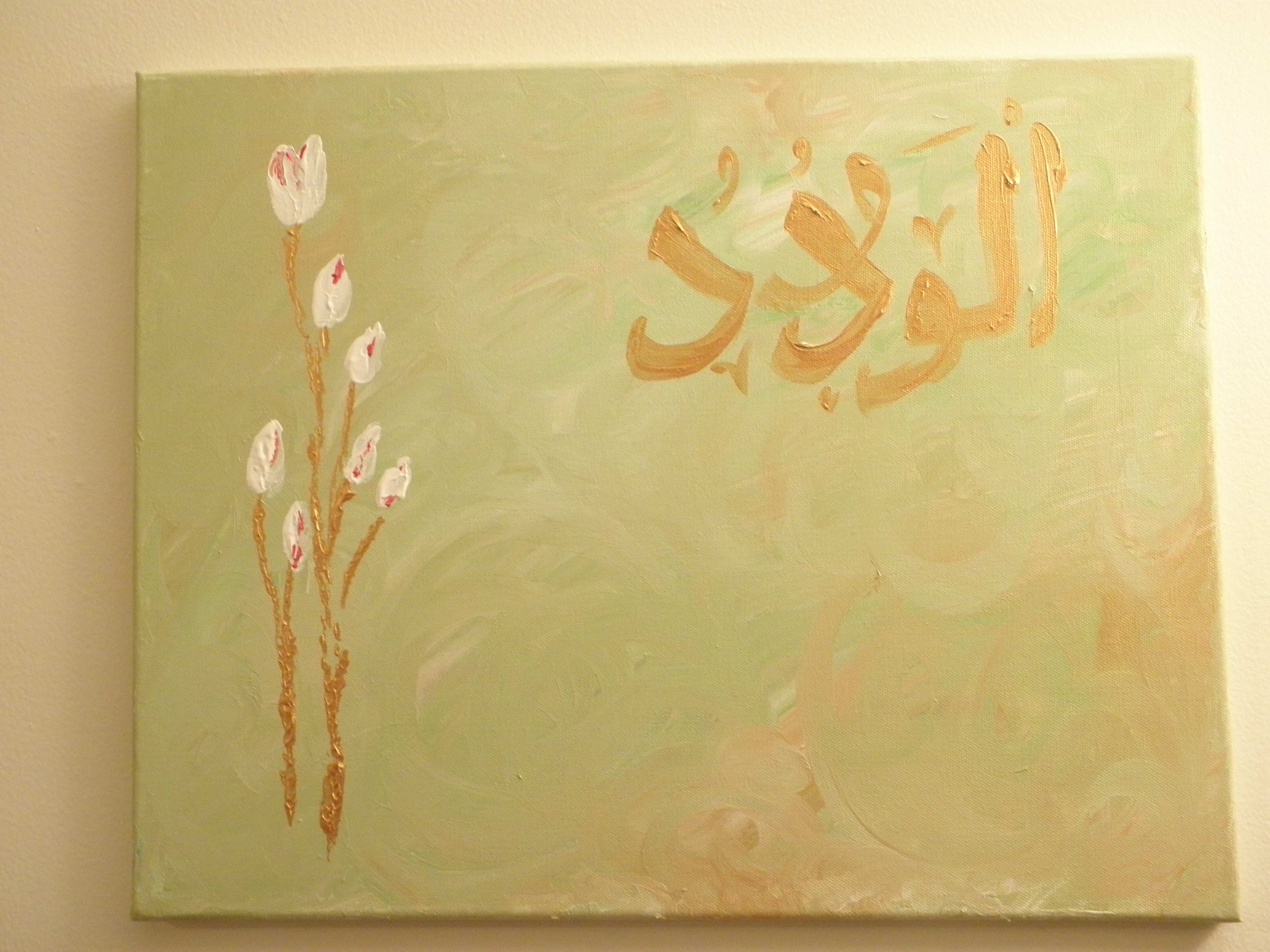
I have been thinking recently on this idea of attachment. That by attaching oneself to objects and things and even people, we feel emptiness inside when they are removed from us. Sr. Yasmin speaks of this a great deal. Love is indeed linked to this idea of attachment. And so it is possible to feel deep loss, hurt, pain when one does not feel a reciprocation of the love one gives out, be it to a lover, a relative, a friend. One solution to this, is to detach oneself. But I would disagree with this and say, yes do attach, do feel that deep love and show that. But don’t have expectations from those you give to. Keep your expectations only with Allah. Allah is the sole provider, nourisher, sustainer. Indeed Allah is ‘Al-Wadud’, ‘The Love’. Meaning God alone is the source of all love. So knowing this, when we are only channelled to recieve His devine mercy (Muslims often use the word mercy as a translation of ‘rahma‘, a core attribute of Allah, and one that also has the idea of love in it) and then transmit it, we don’t really expect a reciprocation from the entity we give it to. If at all we recieve something back we realize that person is only also chanelling to us a love from the same source! So we love our Lord more and in His name love those around us. But we do love, and love deeply. And we cry when we miss our loved ones. Even our prophet (peace and blessing of Allah be with him) himself teared when he would remember his first wife after her death. But we are not the slaves of those we love, but only the slave of ‘The Love’, so we know our source never dries up and therefore we are never alone and never need feel that level of heartache that is despair. Which is probably why our beloved prophet marvelled at the condition of a believer and said, “Wondrous are the believer’s affairs. For him there is good in all his affairs, and this is so only for the believer. When something pleasing happens to him, he is grateful, and that is good for him; and when something displeasing happens to him, he is patient, and that is good for him.” (Reported in the hadith collection of Muslim)

These are a few thoughts I wanted to share on the subject. And attached is an image of a painting completed with Allah’s majestic ‘name’ of ‘Al Wadud’, ‘The Love’. It was inspired at a time when I was the recipient of love mashaallah and was deeply in that emotion. So I am grateful for that inspiration and grateful for what I recieved. That too from my beloved glorious Lord!!! So celebrating Allah’s name, and sharing that, is attaching this image.

All good and all benefit is from Allah and Allah alone. So if any of you found anything good in this, that is by God’s grace and I am very humbled to be able to write and I do hope you find this beneficial for you.
May God’s light and peace be with you all

JoyManifest's Blog (c)

Muslim ‘haiku’ :-)

image

I forgot Thee my Lord, and for a moment thought of this world.
So then I lost myself.

-JoyManifest blog (c) 2012.

Facing Depression

You know in the Muslim world, where we are people of faith, we often don’t feel comfortable acknowledging that we too can get depressed. We feel admitting that is tantamount to admiting that our iman is weak. But it is not. It is merely aknowledging that we are going through a bad time, not that we don’t hope it will get better. The trick is to ride the storm and do it with stoicism. I was tempted to say ‘do it with a smile’ but that is a cliche and really belittling the situation. I learned all this listening to this Jumuah khutbah by Sh. Yasir Fazaga, who I heard, was also a registered counselor. I think we in the Muslim world need more professionals in the area of mental health. Teaching us to cope, to say, yes it’s okay, I’m human…I go through ups and downs. There is a beautiful, profound and very wise du’a taught by the prophet (peace and blessings of Allah be upon him) related in the khutbah. Let me paraphrase here…’O Allah, by your knowledge of the unseen, O Allah, by your capability and ability over your creatures, O Allah, extend in my life so long as living is good for me, and O Allah, put an end to my life so long as death is what is best for me’. This du’a is mentioned along with the circumstance of it, about minute 4.00 in the video.

There are a couple things I wanted to express of thoughts on this du’a. First it brings profound peace, in that it aknowledges that life is hard. So it is not wrong to say that. But the wish for death…that should not be the case. Rather give the control over to Allah and believe that if He almighty is keeping you alive, then there is a good reason for it! So it is a trial of patience to wait to know why! :). But the du’a also carries the message that life is a good thing and tells us that we Muslims are meant to enjoy life so we ask for it to be long, and ask Allah to keep it good for us. But look how much more wisdom in the du’a – for we continue by saying that give us death if that be better. There is such a degree of trust in this du’a. Trust that Allah will only make death a better state than the life we lived in the dunya. What this equates to is asking for Jannah…really. It’s that we’ve lived in this world well and now it is time to move on to a more permanent iteration of existence. One, united with our Maker! in complete peace and rest… Subhahanallah! …and with our beloved prophet (sallalaahu alaihi wasalam). InshaAllah may this be the case for all who read this and more. What a beautifully wise, balanced, du’a. Not belittling the sufferers worries, not talking down and preaching patience, but offering a real solution;-put your trust in Allah and give the control over to your loving Lord. Always watchful over you and kind to you. Trust that! it may take time, but don’t loose trust.

May you benefit from this talk as I did and please keep me in your du’a. May Allah remove the oppresion from all those oppresed and may Allah help those in need and help us. May He be closely with us always and we always aware of the deep cherishing nurturing protecting Creator, our Creator and Lord.

On the death of a child

Assaalamu alaikum, peace to all

Tonight I heard from my sister of the death of a dear child, a beautiful little girl who lives down the street from us back home in Sri Lanka. Her family is not well to do, being fruit sellers…but are some of the most kind and giving people I know. Her grandfather in particular, went out of his way to look after my grandmother when she had a stroke…bodily lifting her up and carrying her out to the vehicle waiting to rush her to hospital. Being a manual laborer he had the strength to do it and being as fond of her as he is, often saying ‘she is like a mother to me’, he had the heart. I, stuck on the other side of the globe, and knowing it would take 48 hours to reach there, could only arrive to be by her hospital bedside. Thank God, she survived that attack and then this little child would visit her almost every day to keep her company as she recovered. She was an adorable bunch of mischief, naughty and full of smiles as she played one prank after another. Her name in Sinhala has no particular meaning I know but can be considered to mean ‘flower’ so I will call her that.

Well Flower has died. Of Dengue fever, a mosquito borne disease more deadly than Maleria in my Island home. The Doctors who examined her not being able to diagnose her correctly at first her treatment came too late. ‘Inna ilaihi wa inna lillaahi rajioon’, the beautiful and profound sentence we Muslims are taught to say on the passing of anyone… ‘From God we come and to God we return’. So then as we believe, another angelic soul reunited with the divine presence. Sinless, she will be in heaven, awaiting her parents and praying for them. So then there is peace.

I wonder about the beauty of children. How their presence gives us life. How we remember what is essential when we are with them. I think it is because they are so recently arrived from that divine presence, and unsullied by the world yet, they are able to communicate an angelic nature. Yes, even in their mischief, they are angelic! The prophet (peace and blessings of Allah be upon him) taught us never to hit a child. Glory be to God, what a source of mercy our beloved prophet is!

After the tsunami happened I saw so many children who had died. So many children. Indeed, it was as if my soul shaken to its depths could not feel anymore. Only in blindly going through day after day after day indulging in back breaking work was there solace. Trusting without a shadow of a doubt, that Allah’s help will come and He is the MOST MERCIFUL. And so Allah is indeed the most merciful. Some time after the tsunami, I moved to another country and then moved in to live with a family where there was a beautiful baby. It took 5 years of growing with that child to be healed. Five blissful years of peace playing with a child and the world was right again. So I wonder at my Lord’s way, taking things away but giving back more. All we have to do is be patient. And kind and giving ourselves. All we have to do is learn to trust and that trust softens our speech so that we learn to speak to one another with kindness and gentility. Not a superficial gentility but one that has permeated our very soul. Is this then the way of the Buddha? the way of Lao Tse, of Jesus (peace be upon him) and of our Master Muhammed (peace and blessing of Allah be upon him)?

One of my most beloved sayings of Rasullulah (the messenger of Allah, peace be upon him) is where he stated that the best means of persuasion is the gentle means…but I cannot find this reference and indeed I am also not sure if it is Quranic. Please forgive me for my lapse, but here is a hadith very close in meaning to that

The Prophet Muhammad (peace be upon him) said: “Be gentle and calm. . .because God likes gentleness in all affairs.”
Sahih Al-Bukhari, Volume 8, Hadith 404

This gentleness children possess. It is there in every coo and gurgle and in every time they stretch their arms out to be hugged. It is there when they put their little hands in yours as you walk along. It is there when they sit in your lap and ask for a story to be read to them. And yes, even when those little eyes dance with mischief and they enjoy annoying you, it is there for they want you. They always want you.

Imagine then the angelic presence and to be united with that. Glory be to God. How much we have to learn to be better. And I say this first to myself and then to everyone else. Allah help me.
May the little ones be in an eternal and beautiful peace.

I wanted to share some other ahadith beloved to me in case it is of benefit to you. And indeed remembering our prophet is never anything but a strength and mercy;

Sahih Bukhari Volume 4, Book 56, Number 759:

Narrated ‘Abdullah bin ‘Amr:

The Prophet never used bad language neither a “Fahish nor a Mutafahish. He used to say “The best amongst you are those who have the best manners and character.”

Malik Muwatta Book 47, Number 47.1.8:

Yahya related to me from Malik that he had heard that the Messenger of Allah, may Allah bless him and grant him peace, said, “I was sent to perfect good character.”

Sahih Muslim Book 032, Number 6264:

Abu Huraira reported Allah’s Messenger (may peace be upon him) as saying: Charity does not in any way decrease the wealth and the servant who forgives Allah adds to his respect, and the one who shows humility Allah elevates him in the estimation (of the people).

Sahih Bukhari Volume 1, Book 11, Number 677:

Narrated Anas bin Malik:

The Prophet said, “When I start the prayer I intend to prolong it, but on hearing the cries of a child, I cut short the prayer because I know that the cries of the child will incite its mother’s passions.”

May Allah forgive us all our countless sins, guide and strengthen us!

And may Allah the almighty, most beautiful, kind, generous, glorious and loving Lord, the Almighty, give rest and ease to every parent who has ever had to go through the torture of loosing a child.

Reminding myself

Assalamu alaikum, Peace to all.

I wanted to share two excellent articles I came across on Suhaib Webb’s virtual mosque, reminding me first about the nature of our beloved. I ask your prayers to help me be more like him and my prayers for all of you to. On this note, a very beautiful elder I was blessed to meet once told me to say this prayer whenever possible, it has helped change my life so I will pass on the wisdom…he said to say ‘O God, I do not know what mistake I have done, but forgive me’. It purifies one, and indeed my soul is in heavy need of purification. And a second short prayer to make that unites us all is ‘Allahumma irham ummati Muhammed’, translated to ‘O Allah be merciful to the nation of Muhammed’ a worthy prayer to make after every salah indeed.

Here are the articles. I will cut and paste them and cite the original. Hope they are of benefit inshaallah. Jazakum Allah Khairan

He Kept it Real! (taken from http://www.suhaibwebb.com/personaldvlpt/character/he-kept-it-real/)
Reehab Ramadan | June 6, 2011 5:00 am

Commanded to Love: Part I | Part II | Part III | Part IV | Part V | Part VI | Part VII

Many of us have a wide variety of masks that we put on throughout the day depending on whom we are with and what their expectations are. Some of these masks are masks of patience, masks of gratitude, or masks of kindness. But the ones who see the ‘true us’ are those we live with. They see our faults and the side of us that we would never show to the outside world. When talking to the sahaba (Companions) the Prophet ﷺ (peace be upon him) said, ‘The best of you are those whom are best to their families, and I am the best among you to my family’ (Tirmidhi). One of the wisdoms we can take from this is that it’s easy to be kind to people when you only have to see them a few hours a week, or even a few hours a day. It’s easy to put on a smile and make someone feel like they are worth something when you know that the show you are putting on will end soon. But it takes work, effort, and perseverance to keep up that niceness and compassion with the people you see day-in and day-out. It is with your family that your true colors show. Through the narrations and commentary of the wives of the Prophet ﷺ , we know for a fact that he was not one to wear masks nor was he one to be fake and insincere.

One of these narrations is of the time when the Prophet came bursting into the house of our mother, Khadija radi Allahu `anha (may God be pleased with her), seeking refuge from the experience he had just been through and begging her to cover him up. After listening to the story of what had occurred in the cave, which we now know was the beginning of the revelation, Khadija (ra) didn’t rush to call him a mad man, laugh at him, or even feel sorry for him. Rather, she had full confidence that something amazing was happening by the will of Allah subhanahu wa ta`ala (exalted is He) because she knew of his noble qualities. She began to comfort him, reminding him of all the good things that he consistently did, assuring him that there is no way that Allah (swt) would abandon him or allow him to be experiencing this out of madness nor out of possession. She reminded him that he was always good to his relatives, was always true to his word, helped those who were in need, supported the weak, fed his guests and answered the calls of those who were in distress. Had this account of his actions come from extended family or even neighbors, it would be awe-inspiring, but it wouldn’t be as powerful as when it came from the lips of his wife. His wife, a woman who sees him in the different moments of his life, who sees him day and night, who knows him for who he really is when his guard may be down, testifies confidently that he is a man of honor and a man that would never let anyone down.

They say if you really want to know who a man is, ask his wife how he is at home when no strange eyes are watching. Our beloved Prophet ﷺ was the same man behind closed doors as he was in public. His deeds did not change depending on who he was with nor did it change depending on who was watching because he knew that the only One who mattered was Allah (swt), and Allah (swt) could see him no matter where he was. He was not two-faced nor did he switch between different masks. No, the Prophet ﷺ kept it real—no matter where he was.

and

A Man of Mercy (taken from http://www.suhaibwebb.com/personaldvlpt/character/a-man-of-mercy/)
Reehab Ramadan | May 30, 2011 5:00 am

Commanded to Love: Part I | Part II | Part III | Part IV | Part V | Part VI

Today, often times a “religious” person is seen to be someone who is rough and rigid, spouting do’s and don’ts without thinking twice about the emotions of the person being scolded. The Prophet ﷺ, however, was the farthest from any such description. He was a man who was enveloped in mercy, who cared for the weak, encouraged the women, and stood up for anyone in need.

Allah (swt) describes the character of the Prophet ﷺ in the Qura’n when He says:

“So by mercy from Allah, [O Muhammad], you were lenient with them. And if you had been rude [in speech] and harsh in heart, they would have disbanded from about you. So pardon them and ask forgiveness for them and consult them in the matter. And when you have decided, then rely upon Allah. Indeed, Allah loves those who rely [upon Him].” [Qur’an, 3:159]

The Prophet ﷺ did not only have mercy towards the men of his society at a time when women were treated very harshly, he was also busy working against this to replace it with mercy and compassion.

The men at the time of Rasul’Allah ﷺ were privileged with the opportunity to constantly be in his company, learning and growing with him. The women wanted to have such an opportunity, and being the leader that he was, the women did not feel any shyness or fear in requesting this from him. Upon request, the Prophet ﷺ set aside a special time just for the women so that he could answer their questions and help them with what they needed. There is a narration in which the Prophet ﷺ was sitting amongst the women and they were talking loudly to him. Umar came into the room and the women completely changed their demeanor. Seeing this, the Prophet ﷺ did not get angry, nor offended, nor even jealous–rather, he laughed. Umar radi Allahu anh (peace and blessings be upon him), asked the Messenger ﷺ why he laughed at their behavior and he replied that he was amazed at how the women hid the instant they heard Umar’s voice! This angered Umar and he questioned the women, asking how they should fear him yet not the Messenger ﷺ! Their response exemplifies the mercy that Prophet ﷺ had towards these women; they responded confidently that in comparison, Umar (ra) was hot-tempered, while the Prophet ﷺ was the epitome of mercy.

The Prophet ﷺ’s mercy was vast and inclusive. He spread it far and wide to the point that even animals could find refuge in his kindness. Of the many instances that are breathtakingly vibrant with the clemency of RasulAllah ﷺ is that of the helpless bird. ‘Abdullah ibn Mas’ud was traveling with the Prophet ﷺ and a few other men. One of the men took an egg from the bird’s nest. Out of despair, the bird came and flapped its wings at the Prophet ﷺ, and he took immediate notice to her sad state. He turned to his companions and asked them who had made this poor bird miserable. Upon finding out that her egg had been taken, he ordered the man to return the egg to her as a sign of mercy and compassion. At a time when many humans were not being shown kindness, the Prophet ﷺ mastered kindness to mankind and was already encouraging kindness and rights of animals.

Today, we look to the lives of the sahabah and read their stories. Many times, it is hard to comprehend how they had so much energy and drive to do all the things that they did. Their energy stemmed from pure Divine Love which was not built through harsh reprimands or robotic movements—rather, this love was built by being in the presence of the Messenger of Allah ﷺ, seeing his amazing mercy and knowing that if he, the creation of Allah (swt), could exhibit such mercy, then what of his Creator?

Allah help us all be more like our beloved, and please Lord, shower your blessings and salutations upon Muhammed and his family.