Beauty

Watching a beautiful and soothing dance piece, one of the 12 tranditional ‘ballet’s or ‘vannam’ in Sri Lankan classical dance here is a little piece of poetry…it is rather a ‘kaviya’ or a poem that is sung according to a slow melody, where often the last syllable is dragged/elongated. Actually I was just humming this to the tune in the video below and thought I’d share it.

O my Lord, I do glorify you
Whatever beauty I see in myself,
That is from you
Protect me from the harm
that I do to myself
and protects others from it too.

I find it amazing that in so many ancient cultures, nature is revered and celebrated, honored and protected. In Sri Lankan classical dance, the 12 vannams are each a celebration of some form of beauty in nature. For example, this dance celebrates the peacock. Others celebrate the elephant, the swan, the eagle etc. I particularly appreciate that there is no complex emotional story or saga like in Western ballet, but a simple veneration of natural beauty. Indeed it is such a humble approach. Watching these dancers I also got to thinking of the discipline and devotion they give their art. The lead dancer for example is a maestro, who has been training since a child. I got to thinking we are all the vicegerants of God, here on this earth to perfect our dance of devotion and master our weaknesses. So the five time ritual prayer, the rules with food, speech, how we should live every day, or simply, the way of life of our great guide and exemplar, the prophet (peace be upon him) taught us is about training and discipline. How beautiful it must be to see our ‘performance’, that of the true devotee of God therefore. What a beautiful person it is who walks the earth in this way. Perhaps this is why the prophets and great sages are so beloved and revered to this day. No wonder Allah azza wa’jal loves those who remember Him! Men and women who lived and walked this earth in that humility, borne out of discipline and training – they were beautiful to behold! Whether Jesus (peace be upon him) or the Gautama Buddha or Moses or Abraham or Mary or our own beloved Muhammed (peace be upon them all). Allah protect us and help us continue upon this way. It gladdens my heart to know we will have the best teacher in this path. And remember, Allah loves you more than you can ever love yourself for your Creator knows you better than you know yourself and is the one true nurturer.
So I am posting this video in the hopes you too will marvel at the discipline and beauty of these dancers and be soothed by the gentle music. I do not see anything but modesty in it and hope you will too. Sometimes we need to see with the heart.

Peace be with you all

The Love

Assalamu alaikum, peace be with you,

Many a thing; whether short and pithy, long and elaborate, deeply philosophical or traipsingly lighthearted, poem or prose, fiction or real, has been written on love. Far be it from the ability of this novice to attempt to say anything profound on the subject. But I did want to share a few impressions and experiences as a Muslimah and our community’s dealing with the concept of love. These are basically, as my blog was set up to do, musings aloud 🙂

Why is it, that it seems, we Muslims, as a Nation, are almost afraid to use the word ‘love’. Is it because of it’s much over-use and abuse by many peoples and nations before and in our time or are we just afraid to talk about something we do not really understand? Certainly the ‘mystical Muslims’ (for lack of a better term), or those in touch with the inner spiritual Islam, have no aversion to using this word. But the vast sunni Muslim community (or at least, the community I’ve interacted with, which is primarily the Muslims of the Indian sub-continent, my own Island home and this multi-ethnic multi-national community of Muslims in Canada and the USA) seems to shy away from using this word. While I find it common in the language of leaders in other faith groups and even community groups, it is rare to hear it among our Imams and leaders. Nay, it almost seems as if talking of love is considered a weakness by the Ummah (an arabic work meaning ‘nation’ and used to denote the Muslim peoples generally) so our Imams shy away from it. At least this is my impression and I hope I am wrong!

Allah is such a beautiful soft name. Meaning ‘Al-ilah’ or ‘The God’, with no plural form and no masculine or feminine form, it is a word beyond gender. Easily lilting on the tongue, easily breathed with the breath, easily sung in lullabies…’la ilaha illallaah’, that beautiful phrase that affirms a person is a Muslim, translated simply to ‘no God but Allah’ is such a soft and gentle thing. When we talk of Allah, we also use the word Rabb often. ‘Rabb’ is hard to translate, it has the meanings of one who nurtures, nourishes, sustains, guides, looks-after and yes, loves! It can be poorly translated as ‘Lord’ and implies one’s Master and complete source of all things. However, Master is a poor word as it has in it an inherent notion of gender, which in the Muslim theology, God is beyond. But my point was that we use the word ‘Rabb’ often and that word is full of the meaning of love. As a dear sister and mashaallah (by God’s grace) emerging voice in our community Sr. Yasmin Mogahed said, Allah loves you more than your Mother. Indeed Allah created mothers, and instilled in them this divine quality of love (it goes without saying this applies to Fathers just as much). We say, that all our good qualities are only small instances of the much greater divine.

I have been thinking recently on this idea of attachment. That by attaching oneself to objects and things and even people, we feel emptiness inside when they are removed from us. Sr. Yasmin speaks of this a great deal. Love is indeed linked to this idea of attachment. And so it is possible to feel deep loss, hurt, pain when one does not feel a reciprocation of the love one gives out, be it to a lover, a relative, a friend. One solution to this, is to detach oneself. But I would disagree with this and say, yes do attach, do feel that deep love and show that. But don’t have expectations from those you give to. Keep your expectations only with Allah. Allah is the sole provider, nourisher, sustainer. Indeed Allah is ‘Al-Wadud’, ‘The Love’. Meaning God alone is the source of all love. So knowing this, when we are only channelled to recieve His devine mercy (Muslims often use the word mercy as a translation of ‘rahma‘, a core attribute of Allah, and one that also has the idea of love in it) and then transmit it, we don’t really expect a reciprocation from the entity we give it to. If at all we recieve something back we realize that person is only also chanelling to us a love from the same source! So we love our Lord more and in His name love those around us. But we do love, and love deeply. And we cry when we miss our loved ones. Even our prophet (peace and blessing of Allah be with him) himself teared when he would remember his first wife after her death. But we are not the slaves of those we love, but only the slave of ‘The Love’, so we know our source never dries up and therefore we are never alone and never need feel that level of heartache that is despair. Which is probably why our beloved prophet marvelled at the condition of a believer and said, “Wondrous are the believer’s affairs. For him there is good in all his affairs, and this is so only for the believer. When something pleasing happens to him, he is grateful, and that is good for him; and when something displeasing happens to him, he is patient, and that is good for him.” (Reported in the hadith collection of Muslim)

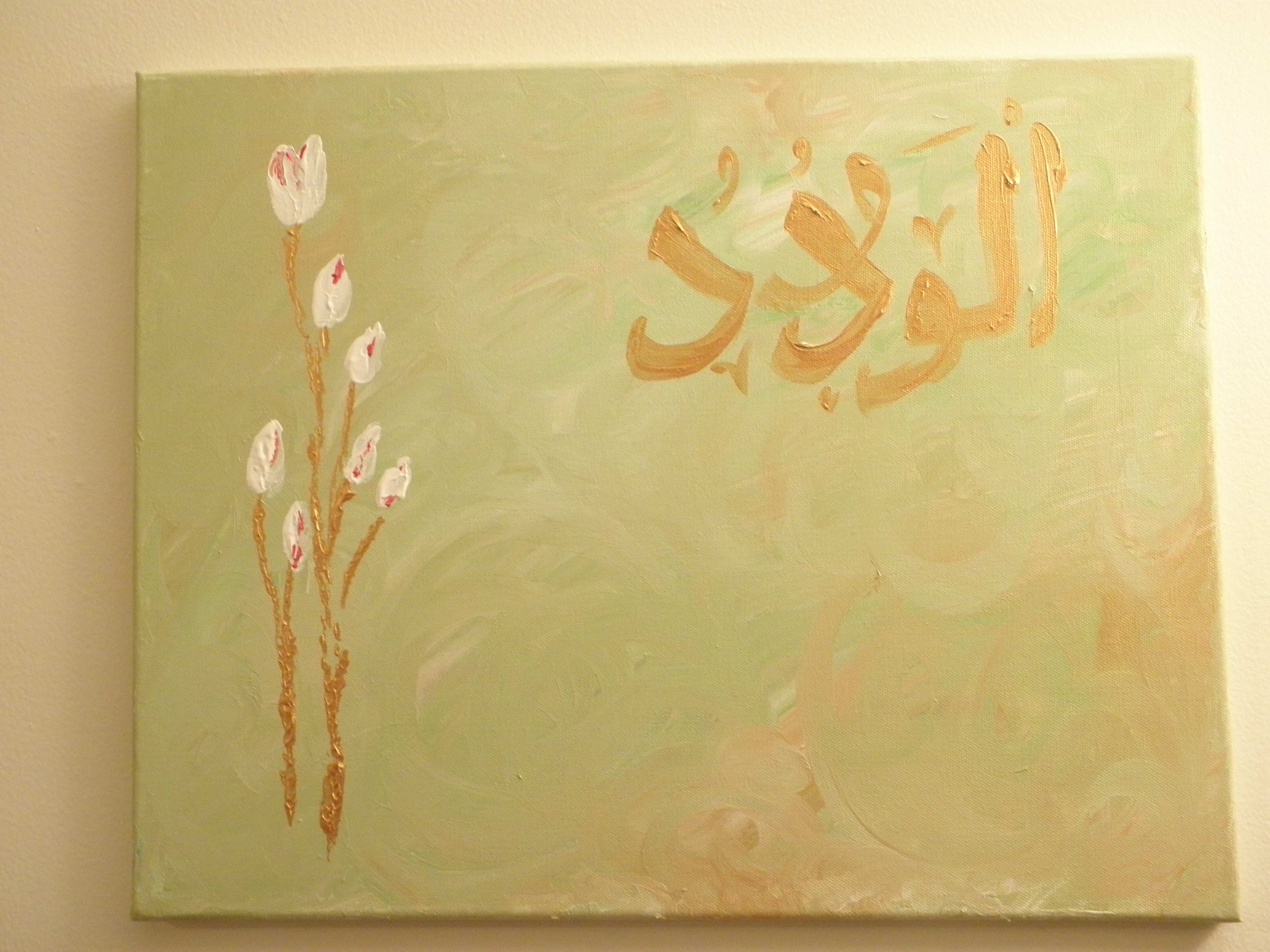
These are a few thoughts I wanted to share on the subject. And attached is an image of a painting completed with Allah’s majestic ‘name’ of ‘Al Wadud’, ‘The Love’. It was inspired at a time when I was the recipient of love mashaallah and was deeply in that emotion. So I am grateful for that inspiration and grateful for what I recieved. That too from my beloved glorious Lord!!! So celebrating Allah’s name, and sharing that, is attaching this image.

All good and all benefit is from Allah and Allah alone. So if any of you found anything good in this, that is by God’s grace and I am very humbled to be able to write and I do hope you find this beneficial for you.
May God’s light and peace be with you all

JoyManifest's Blog (c)

Facing Depression

You know in the Muslim world, where we are people of faith, we often don’t feel comfortable acknowledging that we too can get depressed. We feel admitting that is tantamount to admiting that our iman is weak. But it is not. It is merely aknowledging that we are going through a bad time, not that we don’t hope it will get better. The trick is to ride the storm and do it with stoicism. I was tempted to say ‘do it with a smile’ but that is a cliche and really belittling the situation. I learned all this listening to this Jumuah khutbah by Sh. Yasir Fazaga, who I heard, was also a registered counselor. I think we in the Muslim world need more professionals in the area of mental health. Teaching us to cope, to say, yes it’s okay, I’m human…I go through ups and downs. There is a beautiful, profound and very wise du’a taught by the prophet (peace and blessings of Allah be upon him) related in the khutbah. Let me paraphrase here…’O Allah, by your knowledge of the unseen, O Allah, by your capability and ability over your creatures, O Allah, extend in my life so long as living is good for me, and O Allah, put an end to my life so long as death is what is best for me’. This du’a is mentioned along with the circumstance of it, about minute 4.00 in the video.

There are a couple things I wanted to express of thoughts on this du’a. First it brings profound peace, in that it aknowledges that life is hard. So it is not wrong to say that. But the wish for death…that should not be the case. Rather give the control over to Allah and believe that if He almighty is keeping you alive, then there is a good reason for it! So it is a trial of patience to wait to know why! :). But the du’a also carries the message that life is a good thing and tells us that we Muslims are meant to enjoy life so we ask for it to be long, and ask Allah to keep it good for us. But look how much more wisdom in the du’a – for we continue by saying that give us death if that be better. There is such a degree of trust in this du’a. Trust that Allah will only make death a better state than the life we lived in the dunya. What this equates to is asking for Jannah…really. It’s that we’ve lived in this world well and now it is time to move on to a more permanent iteration of existence. One, united with our Maker! in complete peace and rest… Subhahanallah! …and with our beloved prophet (sallalaahu alaihi wasalam). InshaAllah may this be the case for all who read this and more. What a beautifully wise, balanced, du’a. Not belittling the sufferers worries, not talking down and preaching patience, but offering a real solution;-put your trust in Allah and give the control over to your loving Lord. Always watchful over you and kind to you. Trust that! it may take time, but don’t loose trust.

May you benefit from this talk as I did and please keep me in your du’a. May Allah remove the oppresion from all those oppresed and may Allah help those in need and help us. May He be closely with us always and we always aware of the deep cherishing nurturing protecting Creator, our Creator and Lord.

Ramadan rhymes

Simple rhymes to share this beautiful time of dawn…Assalamu alaikum warahmatullah

***

Subhahanallahi wabihamdihi
Words that fill the scales
Said my beloved prophet
Who I long to meet…inshAllah soon
It will be. On that great day
When my scale I fervently pray
Will be filled with
Subhahanallahi wabihamdihi

***

The stomach moans and groans
My senses are numbed with the pain
I count the hours until
My throat can feel the cool rain
Of water..truly
The barren earth is brought to life,
The sun sets and the call rings out
Come to prayer, come to salvation, come to success, come to joy
Come, come!
And so a day’s fast necessary to know what it means to be saved
And to know…
Give, give, to those who are waiting for your aid
A wandering soul finds rest
Taught by a merciful Lord
How to forget the self
For this brief twelfth of a year, to be sanctified.

***

The moon so soft, the faintest crescent
shyly peeps before descending
Oh so gently greets
This bounteous month
Heralding
A peaceful time of prayer and service
It is Ramadan, days resplendent
With God’s glorious kindness
and angels walking among us
Greet your neighbour and share
The time will pass quickly, beware
May it bring you opportunity to polish your heart
Clean your soul and refresh your spirit
May you once more, be whole

****

Peace to all my brothers and sisters this blessed month.

Topical article….’Are women created only for family life’ by Fathi Osman

I came across this article today on Islamicity and will copy-paste it here. It raises a number of issues very topical in the ‘modern’ world. The arguments are clearly expounded and easy to understand. I’m not merely posting it due to presentation however, I do agree with most of the author’s views and found this a refreshing read.

Here is a bio of the author:

Fathi Osman was a prominent Muslim thinker born in Egypt in 1928 and died in Southern California in 2010. He studied the development of contemporary Islamic thinking since 1947. He has written extensively about the process of change in Islamic concepts, human and gender rights in Islamic and Western perspectives, the Islamic approach to pluralism, the analysis of Islamic history and its interpretation. He has published more than 30 books in Arabic and English which represent new approaches in Islamic thinking. Many of his books, including “Reflections” in “Arabia: the Islamic World Review” published in London 1981-1987, have been translated into several languages.

Inna lillahi wa inna ilaihi rajioon..may Allah grant him the highest heaven.

Article:

We have been used to thinking that women have been created for the family life and for raising children, and thus their natural place is in their homes. Nothing in the Quran or Sunna clearly supports such a view or assumption. Such a division of labor between the husband who earns the living of the family and the wife who stays at home doing housework is a societal experience, which has occurred for a very long time throughout history in so many societies, including the Arab society at the time of Islam, and the subsequent Muslim as well as other societies until recent times when change has come out. Women learn and work equally to men, and the family responsibilities are requiring more financial resources. Caring about the home has to be reviewed, and the Prophet’s traditions indicate his assistance to his wives.

However, such a modern experience of women’s work and the consequent need for husband’s help in the housework in so many countries does not necessarily mean that it is an eternal natural law. Social change never stops; and norms are introduced, maintained or abandoned according to their practical benefit.

In English, the verb form “to husband” denotes the mastery and management of the house, and “husbandry” may mean the control of resources and careful management or the or production of plants and animals. The word “groom”-used in bridegroom-is related to feeding. This may merely reflect a societal tradition that has existed throughout history. The Arabic language, however, differently uses the same word “zawj” meaning mate or companion of the other, for both husband and wife. Some may add the feminine suffix “h” to “zawj” to indicate that the word in a particular context means wife, but this is not a linguistic rule or obligation, and the Quran uses the word “zawj” and its plural “azwaj” to mean wife and wives respectively [e.g. 2:35, 102, 232, 234, 240, 4:12, 20, 6:139, 7:19, 13:38, 20:117, 21:90, 23:6, 24:6, 26:166, 33:4, 6, 28, 37, 25, 50, 53, 59, 60:11, 66:1, 3, 5, 70:31, as well as for husband and its plural [e.g. 2:230, 232, 58:1]. One may argue whether a woman’s work is better from various angles for the family than her stay at home or not. I may go further to say that some Muslim women, and non-Muslim as well, may prefer to stay at home, but this does not mean that this is God’s law that is explicitly spelled out in the Quran or the Sunna. The discussion has to be moved from theology to sociology, or from the divine laws to the human thinking and experience.

Moreover, the Arabic word “qawwamun”, with its preposition “‘ala” which describes the relation of men to women in the Quranic verse 4:34, does not imply any superiority, but simply means “taking full care of”. The verse reads: “Men take full care of women, for what God has granted some of them distinctively from the other, and what they may spend out of their possessions”. The distinctiveness between men and women is related to the woman’s pregnancy, delivery, and nursing, which make it necessary that the man should have the responsibility to provide for her needs and the needs of the children, at least when she is hindered with such a distinctive natural function of reproduction. This hindrance is not permanent, and it cannot be a reason to keep the women at home all her life, and neither does it hinder her intellectual and psychological merits. She is not supposed to bear children or raise them all her life, and at a certain age children have to go to school. Further, suppose that a woman may not marry or bear children, what, then, should keep her at home?

It is time to look to the woman as an equal human being, not just as a bearer and raiser of children, a cook, a home-cleaner, or a dishes and dirty-laundry washer etc. The family life and raising children require a join-effort of both the man and the woman. Since the woman has her right and obligation in obtaining an education according to the guidance of Islam, it is good for her personality and for the society, just as it may be good for the family itself to support the woman’s right to work, and as long as this right is beneficial for all parties, it should be secured.

The woman’s right to inheritance is stated in the Quran, and an addition can be supplemented by writing a will which has priority over the mandatory distribution of inheritance stated in the Quran [14:11-12]. The Muslim should feel his/(her) responsibility to write his (her) will as the Quran urges, even when one realizes suddenly that she (he) is on the brink of death without having it prepared [2:180, 240, 5:106-8]. In the society, men and women are equally and jointly in charge of and responsible for one another in fulfilling their collective obligations towards the public as a whole [9:71]. A woman has the right to vote, to be a member of parliament, a minister, a judge, and even an officer in the army. Which jobs may or may not be convenient to her should be decided-by women themselves not imposed on them, according to their own conviction and interests. In a modern state bodies rule not individuals, and women in executive, legislative and judiciary positions are included in bodies and are subject to a system. Laws are codified, and discretionary decisions are subject to be reviewed by those who have higher positions or by the courts. Not a single man or women has absolute power in a modern state.

Considering two women equal to one man in witnessing a documentation of a credit is connected with a certain practical consideration that is explicitly mentioned in the Quranic text: “so that if one of them [the two women] might make a mistake, the other could remind her” [Quran 2:282]. Women might not in general be familiar with business matters and their financial and legal requirements, especially in Arabia at the time of the Prophets message, but this does not mean that a woman who has had the necessary education or business experience cannot be equal to a man in this respect. Classical jurists pointed out that this is not a general rule for the testimony of a woman, and that the testimony of one woman is sufficient if she knows what she is witnessing and is reliable. In our times, should not a woman who may be a lawyer or an accountant be equal to a man in witnessing a documentation of a transaction? How can some prominent jurists allow a woman to be a judge with full jurisdiction on all matters, if she cannot be a full witness in the first place? Is it not obvious that the limitation regarding her witnessing a document of credit is understood as only conditional and related to certain circumstances?

Monogamy Not Polygyny

What goes with nature and fulfills the “solemn pledge” of marriage is the general rule of marriage in Islam (Quran 4:21). A normal man cannot split his own self into parts, each for a different woman and his children from her. However, Islam allowed – not ordered or recommended – that a man may have another wife exceptionally when this may be necessary. A wife may be seriously and incurably ill for all her remaining life, and her husband may be sincerely committed to take care of her, but he, their children and the ill wife may need badly a woman to take care of the family. It is up to both of the initial wife and the suggested co-wife to accept or reject freely such a second marriage, and no one can impose on any of them a marriage against her will, according to the Islamic law. Each should know that she would be a co-wife, for a legal marriage cannot be mutually based on or maintained on fraud and deception. It is required to register in such a marriage that both the previous and the new wives-know precisely the situation and have no objection.

Islam did not establish polygamy in Arabia nor in the world. Polygyny – the form of polygamy in which a man marries more than one woman – alongside with the reversed form of polygamy: “polyandry” (in which a woman marries more than one husband) still exists in every part of the world, but it is not frequent among African peoples” according to the Academic American Encyclopedia. It is known that polygamy prevailed in the patriarchal age, and was permitted in principle under the Mosaic law, and continued to later times – according to Smith’s Bible Dictionary. The Bible mentioned that Solomon had many wives [I Kings 11:3].

According to the Quran, the permission of marrying more than one wife has several restrictions, as it reads:

“And if you fear that you may cause the orphans injustice, then marry women of your choice who are lawful to you, two, or three, or four, But if you have reason to fear that you may not be able to deal justly with them, then marry only one… This makes it more likely that you will not deviate from the right course for have a family whose maintenance exceeds your ability”‘ (Quran 4:3)

Accordingly:

A ceiling was put to polygyny, restricting the maximum number of legitimate co-wives to four.

It is related to an injustice suffered by the orphans, and widows may be added; a suffering which may refer to after-war circumstances, when many women became widows and have to take care of their orphaned children, including girls in the age of marriage.

Fairness in treating the co-wives is a pre-condition for having more than one wife; otherwise one wife is, the general rule and normal situation “so that you may not deviate from the right course,” through unfair treatment or a lack of due material and moral care for a big family of co-wives and numerous children.

Another Quranic verse shows how almost impossible it is to maintain such an equal fairness among co-wives, and how difficult it is to be even close to such equal fairness (4:129). Injustice would be suffered not only by the co-wives but also by their children who have to live as half brothers and sisters. The required spousal “love and tenderness” (30:21) would certainly be undermined in such complicated “partnership.”

Prophet Muhammad emphasized clearly the general rule and normal situation of monogamy, when he heard that his cousin Ali was to take another wife beside the Prophet’s daughter Fatima, underlining the rights of the wife and her family to know about the other marriage and to reject it. From a practical viewpoint, a woman would never accept to share a man with another woman, unless women outnumber men in certain circumstances, and it may be better to accept the reality temporarily until the balance is restored, rather than to have them suffer psychologically and socially. If the family has to be a model for the whole society in its harmonious relations and fulfillment of all responsibilities (25:74), one man and one women only can establish such a strong and balanced nucleus that can provide such a model in the mutual relations within the family and with the whole society. Polygyny has been permitted with restrictions, exceptionally and temporarily, while men and women were educated and persuaded to develop a monogamous society, which is prevalent now in many Muslim communities. In some Muslim countries, there are laws that control having more than one wife.

The teachings of Islam about the religious and social importance of marriage and the necessity of justice, tranquility and pleasance within the family, have developed in recent times an attitude on monogamy among the Muslims, similar to what occurred before among the Jews, of whom many today may not be aware that polygyny was allowed in their Scriptures and practiced by their ancestors for a longtime time. To this day, cases of polygamy occur among the Yemenite Jews and the Sephardi Jews of the near East.

Modesty Not Segregation

The social role of women requires mixing with men. As Islam does not permit any discrimination between men and women, nor does it advocate a segregation between them as it may be widely understood because of long-standing socio-cultural practices or views. What Islam forbids actually is that one man and one woman stay together in seclusion and privacy (khalwa), if they are not married to each other but they are marriageable according to Shari’a. “Khalwa” cannot apply to a public place, or a place in which others may enter any time such as small offices and shops.

Modesty is required in the outdoor dress for both Muslim women and men. However, there is no specific uniformed dress recommended for a Muslim woman. Purda, chadour, ‘abaya, quftan or hayik are local fashions preferred by women in particular places, and may be changed in any time according to the change of taste. However, various designs or fashions should comply with the basic and permanent requirements of an Islamic dress. The Quran underlines such requirements for a woman’s dress in the following verse:

“O Prophet! Tell your wives and your daughters as well as all [other] believing women that hey should draw over themselves some of their outer garments [when in public]: this will be more conducive to being recognized [as decent women] and not annoyed.” (Quran 33:59)

Moreover, certain decent behavior has to be observed beyond the dress:

“Tell the believing men to lower their gaze and to be [mindful of their chastity and] guarding their private parts, this is more conducive to their purity. …And tell the believing women to lower their gaze and to be [mindful of their chastity and] guarding their private parts, and not to display their charms [in public] beyond what may [decently] be apparent thereof; hence let them draw their head-coverings over their bosoms… and let them not tap [the ground] with their legs [in walking] so as to draw attention to their hidden charms…” [Quran 24:30-31].

Muhammad Asad comments: “Khimra” denotes the head-covering customarily used by Arabian women before and after the advent of Islam. According to most of classical commentators, it was worn in pre-Islamic times more or less as an ornament and was let down loosely over the wearer’s neck; and since the fashion of the time [made] a wide opening in the front of the upper part of a woman’ tunic, this allowed her breast to be bare. Hence, covering the bosom by khimar does not necessarily relate to the use of khimar as such, but is rather to make it clear that a womanÕs breast [should be covered and] is not included in “what may decently be apparent” of her body.

In this light, Islam allows any dress that fulfills the required modesty for a decent woman, and the creativity of fashion designers has to combine elegance and modesty in women’s dresses since one does not negate the other. The attractiveness and respectability of a woman – the same as of a man – are due to one’s personality as a whole, with all intellectual and psychological dimensions, and not to what is physically exposed of one’s body. It is against the human dignity and equality to focus on the physical attraction of a woman, in her social performance with men, the same as this is required from men when they associate with women. In an open society, men and women are equally responsible in “enjoying the doing of what is right and good and forbidding the doing of what is wrong and evil” (Quran 9:71).

Comments are welcome. Peace to all!

On the death of a child

Assaalamu alaikum, peace to all

Tonight I heard from my sister of the death of a dear child, a beautiful little girl who lives down the street from us back home in Sri Lanka. Her family is not well to do, being fruit sellers…but are some of the most kind and giving people I know. Her grandfather in particular, went out of his way to look after my grandmother when she had a stroke…bodily lifting her up and carrying her out to the vehicle waiting to rush her to hospital. Being a manual laborer he had the strength to do it and being as fond of her as he is, often saying ‘she is like a mother to me’, he had the heart. I, stuck on the other side of the globe, and knowing it would take 48 hours to reach there, could only arrive to be by her hospital bedside. Thank God, she survived that attack and then this little child would visit her almost every day to keep her company as she recovered. She was an adorable bunch of mischief, naughty and full of smiles as she played one prank after another. Her name in Sinhala has no particular meaning I know but can be considered to mean ‘flower’ so I will call her that.

Well Flower has died. Of Dengue fever, a mosquito borne disease more deadly than Maleria in my Island home. The Doctors who examined her not being able to diagnose her correctly at first her treatment came too late. ‘Inna ilaihi wa inna lillaahi rajioon’, the beautiful and profound sentence we Muslims are taught to say on the passing of anyone… ‘From God we come and to God we return’. So then as we believe, another angelic soul reunited with the divine presence. Sinless, she will be in heaven, awaiting her parents and praying for them. So then there is peace.

I wonder about the beauty of children. How their presence gives us life. How we remember what is essential when we are with them. I think it is because they are so recently arrived from that divine presence, and unsullied by the world yet, they are able to communicate an angelic nature. Yes, even in their mischief, they are angelic! The prophet (peace and blessings of Allah be upon him) taught us never to hit a child. Glory be to God, what a source of mercy our beloved prophet is!

After the tsunami happened I saw so many children who had died. So many children. Indeed, it was as if my soul shaken to its depths could not feel anymore. Only in blindly going through day after day after day indulging in back breaking work was there solace. Trusting without a shadow of a doubt, that Allah’s help will come and He is the MOST MERCIFUL. And so Allah is indeed the most merciful. Some time after the tsunami, I moved to another country and then moved in to live with a family where there was a beautiful baby. It took 5 years of growing with that child to be healed. Five blissful years of peace playing with a child and the world was right again. So I wonder at my Lord’s way, taking things away but giving back more. All we have to do is be patient. And kind and giving ourselves. All we have to do is learn to trust and that trust softens our speech so that we learn to speak to one another with kindness and gentility. Not a superficial gentility but one that has permeated our very soul. Is this then the way of the Buddha? the way of Lao Tse, of Jesus (peace be upon him) and of our Master Muhammed (peace and blessing of Allah be upon him)?

One of my most beloved sayings of Rasullulah (the messenger of Allah, peace be upon him) is where he stated that the best means of persuasion is the gentle means…but I cannot find this reference and indeed I am also not sure if it is Quranic. Please forgive me for my lapse, but here is a hadith very close in meaning to that

The Prophet Muhammad (peace be upon him) said: “Be gentle and calm. . .because God likes gentleness in all affairs.”
Sahih Al-Bukhari, Volume 8, Hadith 404

This gentleness children possess. It is there in every coo and gurgle and in every time they stretch their arms out to be hugged. It is there when they put their little hands in yours as you walk along. It is there when they sit in your lap and ask for a story to be read to them. And yes, even when those little eyes dance with mischief and they enjoy annoying you, it is there for they want you. They always want you.

Imagine then the angelic presence and to be united with that. Glory be to God. How much we have to learn to be better. And I say this first to myself and then to everyone else. Allah help me.
May the little ones be in an eternal and beautiful peace.

I wanted to share some other ahadith beloved to me in case it is of benefit to you. And indeed remembering our prophet is never anything but a strength and mercy;

Sahih Bukhari Volume 4, Book 56, Number 759:

Narrated ‘Abdullah bin ‘Amr:

The Prophet never used bad language neither a “Fahish nor a Mutafahish. He used to say “The best amongst you are those who have the best manners and character.”

Malik Muwatta Book 47, Number 47.1.8:

Yahya related to me from Malik that he had heard that the Messenger of Allah, may Allah bless him and grant him peace, said, “I was sent to perfect good character.”

Sahih Muslim Book 032, Number 6264:

Abu Huraira reported Allah’s Messenger (may peace be upon him) as saying: Charity does not in any way decrease the wealth and the servant who forgives Allah adds to his respect, and the one who shows humility Allah elevates him in the estimation (of the people).

Sahih Bukhari Volume 1, Book 11, Number 677:

Narrated Anas bin Malik:

The Prophet said, “When I start the prayer I intend to prolong it, but on hearing the cries of a child, I cut short the prayer because I know that the cries of the child will incite its mother’s passions.”

May Allah forgive us all our countless sins, guide and strengthen us!

And may Allah the almighty, most beautiful, kind, generous, glorious and loving Lord, the Almighty, give rest and ease to every parent who has ever had to go through the torture of loosing a child.

Reminding myself

Assalamu alaikum, Peace to all.

I wanted to share two excellent articles I came across on Suhaib Webb’s virtual mosque, reminding me first about the nature of our beloved. I ask your prayers to help me be more like him and my prayers for all of you to. On this note, a very beautiful elder I was blessed to meet once told me to say this prayer whenever possible, it has helped change my life so I will pass on the wisdom…he said to say ‘O God, I do not know what mistake I have done, but forgive me’. It purifies one, and indeed my soul is in heavy need of purification. And a second short prayer to make that unites us all is ‘Allahumma irham ummati Muhammed’, translated to ‘O Allah be merciful to the nation of Muhammed’ a worthy prayer to make after every salah indeed.

Here are the articles. I will cut and paste them and cite the original. Hope they are of benefit inshaallah. Jazakum Allah Khairan

He Kept it Real! (taken from http://www.suhaibwebb.com/personaldvlpt/character/he-kept-it-real/)
Reehab Ramadan | June 6, 2011 5:00 am

Commanded to Love: Part I | Part II | Part III | Part IV | Part V | Part VI | Part VII

Many of us have a wide variety of masks that we put on throughout the day depending on whom we are with and what their expectations are. Some of these masks are masks of patience, masks of gratitude, or masks of kindness. But the ones who see the ‘true us’ are those we live with. They see our faults and the side of us that we would never show to the outside world. When talking to the sahaba (Companions) the Prophet ﷺ (peace be upon him) said, ‘The best of you are those whom are best to their families, and I am the best among you to my family’ (Tirmidhi). One of the wisdoms we can take from this is that it’s easy to be kind to people when you only have to see them a few hours a week, or even a few hours a day. It’s easy to put on a smile and make someone feel like they are worth something when you know that the show you are putting on will end soon. But it takes work, effort, and perseverance to keep up that niceness and compassion with the people you see day-in and day-out. It is with your family that your true colors show. Through the narrations and commentary of the wives of the Prophet ﷺ , we know for a fact that he was not one to wear masks nor was he one to be fake and insincere.

One of these narrations is of the time when the Prophet came bursting into the house of our mother, Khadija radi Allahu `anha (may God be pleased with her), seeking refuge from the experience he had just been through and begging her to cover him up. After listening to the story of what had occurred in the cave, which we now know was the beginning of the revelation, Khadija (ra) didn’t rush to call him a mad man, laugh at him, or even feel sorry for him. Rather, she had full confidence that something amazing was happening by the will of Allah subhanahu wa ta`ala (exalted is He) because she knew of his noble qualities. She began to comfort him, reminding him of all the good things that he consistently did, assuring him that there is no way that Allah (swt) would abandon him or allow him to be experiencing this out of madness nor out of possession. She reminded him that he was always good to his relatives, was always true to his word, helped those who were in need, supported the weak, fed his guests and answered the calls of those who were in distress. Had this account of his actions come from extended family or even neighbors, it would be awe-inspiring, but it wouldn’t be as powerful as when it came from the lips of his wife. His wife, a woman who sees him in the different moments of his life, who sees him day and night, who knows him for who he really is when his guard may be down, testifies confidently that he is a man of honor and a man that would never let anyone down.

They say if you really want to know who a man is, ask his wife how he is at home when no strange eyes are watching. Our beloved Prophet ﷺ was the same man behind closed doors as he was in public. His deeds did not change depending on who he was with nor did it change depending on who was watching because he knew that the only One who mattered was Allah (swt), and Allah (swt) could see him no matter where he was. He was not two-faced nor did he switch between different masks. No, the Prophet ﷺ kept it real—no matter where he was.

and

A Man of Mercy (taken from http://www.suhaibwebb.com/personaldvlpt/character/a-man-of-mercy/)
Reehab Ramadan | May 30, 2011 5:00 am

Commanded to Love: Part I | Part II | Part III | Part IV | Part V | Part VI

Today, often times a “religious” person is seen to be someone who is rough and rigid, spouting do’s and don’ts without thinking twice about the emotions of the person being scolded. The Prophet ﷺ, however, was the farthest from any such description. He was a man who was enveloped in mercy, who cared for the weak, encouraged the women, and stood up for anyone in need.

Allah (swt) describes the character of the Prophet ﷺ in the Qura’n when He says:

“So by mercy from Allah, [O Muhammad], you were lenient with them. And if you had been rude [in speech] and harsh in heart, they would have disbanded from about you. So pardon them and ask forgiveness for them and consult them in the matter. And when you have decided, then rely upon Allah. Indeed, Allah loves those who rely [upon Him].” [Qur’an, 3:159]

The Prophet ﷺ did not only have mercy towards the men of his society at a time when women were treated very harshly, he was also busy working against this to replace it with mercy and compassion.

The men at the time of Rasul’Allah ﷺ were privileged with the opportunity to constantly be in his company, learning and growing with him. The women wanted to have such an opportunity, and being the leader that he was, the women did not feel any shyness or fear in requesting this from him. Upon request, the Prophet ﷺ set aside a special time just for the women so that he could answer their questions and help them with what they needed. There is a narration in which the Prophet ﷺ was sitting amongst the women and they were talking loudly to him. Umar came into the room and the women completely changed their demeanor. Seeing this, the Prophet ﷺ did not get angry, nor offended, nor even jealous–rather, he laughed. Umar radi Allahu anh (peace and blessings be upon him), asked the Messenger ﷺ why he laughed at their behavior and he replied that he was amazed at how the women hid the instant they heard Umar’s voice! This angered Umar and he questioned the women, asking how they should fear him yet not the Messenger ﷺ! Their response exemplifies the mercy that Prophet ﷺ had towards these women; they responded confidently that in comparison, Umar (ra) was hot-tempered, while the Prophet ﷺ was the epitome of mercy.

The Prophet ﷺ’s mercy was vast and inclusive. He spread it far and wide to the point that even animals could find refuge in his kindness. Of the many instances that are breathtakingly vibrant with the clemency of RasulAllah ﷺ is that of the helpless bird. ‘Abdullah ibn Mas’ud was traveling with the Prophet ﷺ and a few other men. One of the men took an egg from the bird’s nest. Out of despair, the bird came and flapped its wings at the Prophet ﷺ, and he took immediate notice to her sad state. He turned to his companions and asked them who had made this poor bird miserable. Upon finding out that her egg had been taken, he ordered the man to return the egg to her as a sign of mercy and compassion. At a time when many humans were not being shown kindness, the Prophet ﷺ mastered kindness to mankind and was already encouraging kindness and rights of animals.

Today, we look to the lives of the sahabah and read their stories. Many times, it is hard to comprehend how they had so much energy and drive to do all the things that they did. Their energy stemmed from pure Divine Love which was not built through harsh reprimands or robotic movements—rather, this love was built by being in the presence of the Messenger of Allah ﷺ, seeing his amazing mercy and knowing that if he, the creation of Allah (swt), could exhibit such mercy, then what of his Creator?

Allah help us all be more like our beloved, and please Lord, shower your blessings and salutations upon Muhammed and his family.

Reviving the Islamic Spirit …and the need for it

Alhamdulillah it is good to be back to writing again. Who ever thought my next post would be written laying on a bed in the same hotel I was staying at last year in Long Beach, California! More importantly, that I am back here to attend again the RIS conference. RIS for Reviving the Islamic Spirit, is a fantastic affair..why? Not simply due to the amazing line-up of speakers, the ability to deliver topical sessions year after year, the ever growing attendance and the palpable feeling of ‘barakah’ in the air… but also because this massive event was first envisioned and has been organized and put together every year by youth volunteers. Yep, young working Muslims in Toronto first started it and now after 9 years, they have branched off to a US version too. I am very happy with the latter as its cheaper for me to attend :), but the Toronto convention is about 3 times larger.

Indeed, initiatives like this are so essential. It is a time when events on the global stage are calling us everyday as Muslims, to rise up and let our voices be heard. It is time for us to define ourselves. And to do that, first we must learn Islam. Perhaps then appropriately, this year’s conference is titled ‘Removing the veil of Muslims from Islam’!

Now that I mentioned it, I wonder about that ‘palpable feeling of barakah’ present… is it because of this beautiful truth, where the prophet (peace and blessings of Allah be on him) who said, in a hadith Qudsi… Allah Kareem! And Allah knows best

On the authority of Abu Hurairah (radiAllaahu anhu) that the Prophet (sallAllaahu alayhi wa sallam) said :
Whoever removes a worldly grief from a believer, ALLAH will remove from him one of the griefs of the Day of Resurrection. And whoever alleviates the need of a needy person, ALLAH will alleviate his needs in this world and the Hereafter. Whoever shields [or hides the misdeeds of] a Muslim, ALLAH will shield him in this world and the Hereafter. And ALLAH will aid His Slave so long as he aids his brother. And whoever follows a path to seek knowledge therein, ALLAH will make easy for him a path to paradise. no people gather together in one of the houses of ALLAH, reciting the Book of ALLAH and studying it among themselves, except that Sakeenah (Tranquility) descends upon them, and Mercy envelops them, and the angels surround them, and ALLAH mentions them amongst those who are with Him. And whoever is slowed down by his actions, will not be hastened forward by his lineage.
It was related by Muslim in these words.

On that note, the exciting news is that RIS has launched a website, allowing live streams of the talks as well as access to previous talks. It is not free however, I think that is necessary to fund the project. I heard RIS Toronto has been running in the green, but RIS USA has been in the red unfortunately. They only began last year so inshaAllah it will soon catch up. Here is the website. http://www.revivingtheislamicspirit.com/streaming/
Check it out..it has some nice features.

I also remembered I had ‘reported’ a previous RIS I attended… here are the links if in case it is useful… rather disjointed, but will hopefully give you an idea for the feel of this event; part 1 and part 2.

Finally, I’ll leave you with a sweet song by Maher Zain, performed last year at RIS much to everyone’s joy. This version is from Toronto though

Generating real scholars and Zaytuna

Assalamu alaikum, peace to all. It’s been a while since I logged on here. Many life events came in the way…mashaAllah very happy ones :).

However there have also been a bunch of posts in my head that have piled up over the days I want to put down…hoping to get started today. The first of May, a beautiful spring day that has only gotten ‘springier’ since the first gorgeous day on Friday. And blessed am I to be living in one of the most beautiful places on earth! Shukr wa Hamd Allah (thanks and praise to God). On that note, one long planned blog is to share that spring beauty with posting some pictures up here I was fortunate to take. You see, after years of having only a poor camera (the cheapest I could find) that I bought simply to be able to take pictures of slides from talks at conferences (my cheat-sheet on remembering large volumes of data that gets presented at scientific meetings ;)….this was before they banned the use of cameras at talks saying it was distracting..hrmp!), the past boxing day I found a dandy one going for 50% off and still within budget (100$). So this spring I did find odd moments off to walk about and test it out. Rather hoping to do so more and so expect a few photo-journal entries inshaAllah. Hope you will like them and my camera and eye won’t let me down 🙂

That long preamble done. Here is what I wanted to write of today. The need for good scholars in our community. Its well known (or may not be known at all) that the Muslim ummah has lost or had greatly reduced its history of good religious scholarship the past two to three hundred years, mainly due to the effects of Colonialism. However its roughly been about half a century since the fall of the last Colonial empire (I mean the British…and lets not go in to the USA driven neo-imperialism the world is witnessing now), and mashaAllahu ta’ala we now are witnessing more and more the resurgence of Muslim thought and scholarship.

There are now great luminaries in the Muslim world who are transforming their communities and energizing the Muslim ummah with thought and action. Also important, these are not self-trained, but those who have patiently studied with the best scholars left in the Muslim world that has been somehow preserved in-tact through the ages. Scholars like Sheikh Murabit al Haj who has lived his entire life learning and teaching the Quran in the Sahara desert and did not see a single ‘white’ person until Hamza Yusuf Hanson took his long camel ride to meet him (see this blog post for a precious insight in to Sh. Murabit al Haj’s life). That meeting as the now Sheikh Hamza recounted once, inspired by a dream that he and his teacher had both shared. Subhahanallah (glory be to God), God’s work is being done and will be done despite ever cynic and skeptic that ever lived. Sheikh Hamza is one of the best scholars in the world today. A true polymath he excels with ease on any topic. Mashaallah I’ve spent many a day listening to him speak as I cook/clean and truly learned volumes. Sh. Abdul Hakim Murad, or Professor Tim Winter of Cambridge University, Imam Zaid Shakir who has developed so many community service initiatives, a former USA army man, are other amazing scholars I can think of off the top of my head. If you haven’t heard them, do youtube them… they will offer a glimpse in to true Islam and open your mind and heart to heights and truths that are as deeply peaceful as they are uplifting. And if you have, please do share these gems with me! I will greatly appreciate it!

To resume, Sh. Hamza and Imam Zaid have begun Zaytuna College. The first Muslim ‘seminary’ in North America based at Berkeley University in California. Please do check out their website. I am very excited about the new generation of leaders that are being taught here. The first batch of students are a beautiful mixture of experience and background ….and… of the 15 students, 9 are female!!! (sorry, couldn’t hide my excitement :D..oh how great it will be to see the resurgence of the Muslimah scholar).

If you can do consider becoming a zaytuna companion. An ‘ansar’ to a worthy cause. Sh. Hamza modeled a reward program for the ansar based on the life of the prophet (peace be upon him), where instead of the calling a donor a ‘gold’, ‘platinum’, ‘silver’ etc depending on the amount of funds you give, he said the most precious in their eyes are the first ones to help, regardless of how much they helped with. The first to answer that call. Now isn’t that very touching… it makes me wonder of the great power of our beloved prophet (peace and blessing of Allah be upon him) to move hearts… Zaytuna companions are treated as intimate friends of the college and given recourse to all the guest lectures that the students there get to attend. I cannot insert a post of Zaytuna programming in here, but this link will take you to their youtube channel inshaAllah

Also I wanted to share this talk given by Sh. Hamza on the lives of men. It’s a 2.5 hour lecture and is available in parts on youtube (I’ll share the first part and you can find the rest) or as a whole, but that is poorly edited (I’ll share that too). I think he gave it at the ‘workshop on Islam for high school teachers’ conducted in Abiqueu in New Mexico based solely on what the architecture of the room looks like (!). This is a truly amazing series conducted free by DaralIslam an organization that sounds very impressive but that I do not know much more about.

The idea of the workshop seems to be to educate high school teachers, predominantly non-Muslim, on what Islam is all about. Super!

Here are the youtube videos on the talk ‘the lives of man’ .. first the 10 min video, 1 of 16 parts

and full length here

Our only true enemy… ‘The whisperer’

MashaAllahu ta’ala the past few weeks have brought fresh illumination as in our study circle we’ve been learning about the real enemy. The one and only enemy. As told by God to us in His book, we have only one enemy very clearly;

O you who believe! enter into submission one and all and do not follow the footsteps of Shaitan; surely he is your open enemy.
Quran 2:208

While I don’t want to paraphrase all I’ve been learning about the shayateen (devils) in the past weeks in to a few words on one post, I think there certainly is a simple take-home message. That really there is evil, but that evil is only the devil and all he can do is whisper. He tempts, deceives, confuses and moves man to great sin thereby. But in the end, he is not to be feared but only treated with contempt. And our Lord we seek refuge in from his devious whispers. But more importantly that all this cause of hatred/anger/jealousy really is not people but the one real enemy. How many wars are being fought, where brother kills brother, each pandering some truth as a truth above another’s truth. The US Army over the VietCon (Vietnam war), Iraq over Iran (Iran-Iraq conflict), the Gulf war…the list is endless… and now the situation in Libya. Fast deteriorating in to an all out civil war, one wonders what happened to the truth in this conflict.

As someone so wisely said (I forget who, was it Bernard Shaw?) ‘truth is the first casualty in war’.

So hate the sin, but not the sinner. If we hate the oppression wrought by an oppressor, we do not hate the oppressor himself, but only wish for him the same salvation we yearn for ourselves. The vital hadith again;

‘None of you truly believes until he loves for his brother what he loves for himself’
– look at how strong this hadith is, recorded by al-Bukhari (13), Muslim (45), Ahmad (3/176), at-Tirmidhi (5215), Ibn Majah (66), an-Nasa’i (8/115), and Ibn Hibban (234)

Wanting that same salvation, that same peace for everyone is essential to training our hearts to that state of purity demanded by the fact that only those with a sound/serene/peaceful heart will be saved on that day

وَلَا تُخْزِنِي يَوْمَ يُبْعَثُونَ
يَوْمَ لَا يَنفَعُ مَالٌ وَلَا بَنُونَ
إِلَّا مَنْ أَتَى اللَّـهَ بِقَلْبٍ سَلِيمٍ

And do not disgrace me on the Day they are [all] resurrected
The Day when there will not benefit [anyone] wealth or children
But only one who comes to Allah with a sound heart.”

Quran (26:87-89)

So hate the sin but not the sinner. This was beautifully expanded on by Sh. Hamza in his article expounding on Divine Love as understood by the Muslim tradition. An article very much worth reading and passed on. It can be found here

Without going on too much about it, here is in verse form some of that which mashaAllah I’ve learned about all this. I hope it is of benefit inshaAllah. Called ‘the whisperer’

The whisperer

Whispers have brought down empires
From Shakespearan tragedies to real life
Desdemona and Othello to
every day in some every day home
some husband walks out on his wife

A neighbour has whispered
On the streets a rumour spread
Brothers do not speak with brothers
for years. Nor their sisters
fathers, mothers
They are afraid to allow
the possibility that the human errs
Afraid to forgive lest it reduce ‘honour’
or display weakness?

Fools proclaimed in self righteous glory
Sit on your high seat till you taste that same sloth
of the sinner when sin you commit unknowingly
or in a moment of weakness, that you do not forgive in another

The devils can only whisper
And we have no other enemy
No other. Remember Abu Sufyan? Not an enemy but in the end
the Muslim brother. And that great sword of the deen
Khaled, once the attempted excutioner of the prophet

A mercy to the worlds

O Patient man. Teach us your patience
Your people are in disarray
They kill each other inventing enemies
Spurring on deeds of fresh bloodshed
While screaming ‘Allahu akber’

Only a heart serene will be saved on that day
Didn’t you read your book? Held aloft while you screech.
Ah, what are you screeching for?

Perhaps a little silence will lift that veil of ignorance
The constant cacophony of mad passion
Drowned out the whisperer so close to your ear
who has never ceased whispering…
stop the gun so you can hear

A vile enemy that is whispering
Just a whisperer. Just a doomed whisperer

Then love your brother
Your messenger honour. Worry eradicate
All the burdens of the earth fall away from heavy shoulders
You can now fight, knowing what you are fighting for
Just one enemy. Remember.

O my Lord, I seek refuge in Thee
And Thou art sufficient for me.

Copyright – Joymanifest’s blog. 2011

***