This is a beautiful song, it melted my heart and made me remember what foolish things I worry about. It is the more impactful for it features the World Food Program, an organization I used to work for and video footage from Sri Lanka. The days I worked in the UN, with the poor of my country are brought back. Those days, I knew myself better. I was closer to my soul. So I make this prayer and may my Lord grant it, and forgive my sins, ‘O Lord, don’t let me forget the poor. This rich western life has made me forget what it feels like to be hungry. Has made me forget humility. O Lord, protect me from too much wealth’
Please do listen, share and buy this track. As usual Sami Yusuf, Allah bless and fill with light his beautiful soul, has done this for charity. What a inspiration to live liek that. Using your God given talent, to serve God.
The Quran is a phenomenal book. It has about 50 titles, most of which I don’t know. One, the better known is ‘Furqan’, meaning roughly, ‘criterion’, i.e., a way to distinguish between right and wrong. The most commonly used word, ‘Quran’ comes from the root word ‘qara’a’. The arabic root word system is amazing. Root words are usually derived of three letters (in arabic there are no vowels and consonants, it is a phonetic language with diacritical marks denoting vowel sounds), in this case; q-r-a’, which can then be formed in many versions to mean many things that are derived from that root word. ‘qara’a’ means to read a written thing, recite with or without a script, proclaim, convey, call, rehearse, transmit, deliver. In fact the first revealed word, which is found in the Quran as the first verse of chapter (or sura) 96, is ‘iqra’. It was the first revealed word to Muhammed, the final messenger, upon whom God shower peace and blessing, and indeed a fitting opening for what was to follow and the mission he recieved with that word.
One of the Quran’s titles is shifa, meaning a ‘healing’. The recitation of the Quran carries immense healing and calming. Which is why often Muslims, even those who don’t understand arabic (the majority) will know how to recite the Quran. And this recitation has certain rules and methods. The best reciters or ‘qaari’s’ (you can see how the root word system is working!) often lead the prayers in Mosques, as during the prayer, verses of the Quran are recited. These recitations are beautiful and many around the world listen to recordings of them. And such is the healing power of the Quran, that the recording of it’s recitation is often used (i.e., by playing it over radio, internet, tapes etc) to cure people or comfort those who are dying. For myself, the Quran healed a broken heart and also soothed a mind when it was wandering ( I carry schizophrenia susceptibility genes and for a time was almost delusional due to some bad life incidents). Mashaallah (=by God’s grace), the Quran healed me. The words of my Lord are a soothing balm and comforter.
That was a long prelude! But it was organic so I hope you will indulge me and I wanted to explain the context of what reciting means to a Muslim. This is a poem written a few days ago ater a peaceful pre-dawn time of reciting, sitting on a prayer mat that was made of my grandmother’s soft old white sari, folded many times and wearing the white prayer dress of embroidered (white on white) skirt and loose head covering. I hope you will like it and I wish for you many such moments of utter peace and comfort, of such closeness with the divine. Praise and Glory be to Him. To end I want to say, ss Muslims believe, any good in me is from God and God alone.
Recitation
Teaching, guiding, soothing
Each morning before the sun rises
with the birds who wake before dawn
learning their song. I recite
the revealed words of the Creator
As the earth stirs to life
So does my heart.
As the cool gentle breeze of truth
hums within my heartstrings
As the perspicious light of guidance
dissipates the doubt in my brain
As the wise and the true
embellishes itself in my heart
I am but a grateful slave
of the One. One beyond time and place
One closer to me than my conscience
One knowning me better than I do myself
So then peace. In the safest hands
I am gently lead. To a better way to live.
Each morning as I recite
The words of my Lord. The birds sing
And soon it will be dawn.
There is a beautiful moon outside and the night is clear and still. These nights of the full moon of rabiul awwal…the time of the birth of the beloved, the final messenger Muhammed, upon whom be peace and salutations, what beautiful nights they are.
Looking at the moon my heart realizes the prayer Muhammed himself would make on beholding the moon. And so my lips say it too- “O Moon, as thou dost worship my Lord, so do I!”
But tonight I gaze on the moon and add to it this yearning ( and these words are my own) – ‘O Moon, you are the same moon who looked upon the prophet making that prayer. O Moon how blessed you are! I am gazing on you that has seen my beloved and time stands still. How blessed my eyes to behold you! O Moon, as you do worship Allah so do I’
So saying my beloved’s words my heart fills with the light of the answering moon
Thanks and Glory be to God.
I came across this beautiful short talk by Habib Al-Jifri, a great scholar and one of very noble birth, both his parents are descendents of Ali (Allah be pleased with him), the prophet’s couzin. You can read more of his bio here and I have copy-pasted an excerpt from that site below. This talk and the manner in which it is delivered is a beautiful light and a reminder of what a mercy to mankind we were given in our beloved prophet Muhammed. May you benefit from it as I did and may we all come to know more about and love this great man, this light to the worlds.
Bio excerpt of Habib Ali Al-Jifri- ‘He began taking knowledge from his early childhood from his first teacher, his mother’s great-aunt the scholar and knower of God Safiah daughter of Alawi son of Hassan al-Jifri, she had an immense influence on him and the direction he took in the pursuit of knowledge and spirituality.
As a continuation of the authentic methodology of receiving Sacred Knowledge, and wayfaring on the spiritual path, through an unbroken chain of masters, all the way back to the Messenger of God may God Bless him & his family and give them peace, a methodology the preservation and maintenance of which, the valley of Hadramaut and the city of Tarim are renowned, this work was continued in the intellectual Milieu of the Hejaz which became a meeting point for the Scholars of the School of Hadramaut when they were exiled from the South of Yemen during Communist Rule; he received his education in the Sacred Sciences and the Science of Spiritual Wayfaring at the hands of Scholars and Spiritual Educators’
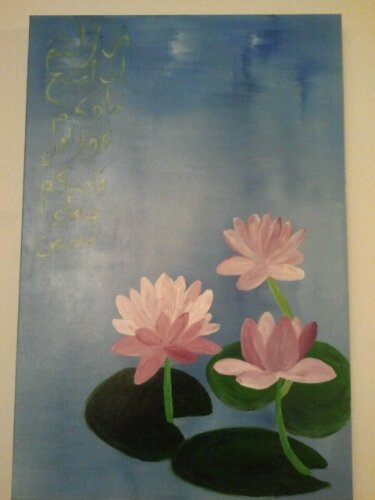
Here is sharing a painting completed a long time ago mashaAllah, inspired by the last ayah of surah Mulk, which is also what is inscribed on it. I wanted to attach it to the recent post where I had talked of this very same ayah, but saved it for later. It is a special work to me 🙂
May you enjoy looking at it. As we say ‘Allah is beautiful and He loves beauty’, so may it be of benefit to you!
Peace be with you all
Watching a beautiful and soothing dance piece, one of the 12 tranditional ‘ballet’s or ‘vannam’ in Sri Lankan classical dance here is a little piece of poetry…it is rather a ‘kaviya’ or a poem that is sung according to a slow melody, where often the last syllable is dragged/elongated. Actually I was just humming this to the tune in the video below and thought I’d share it.
O my Lord, I do glorify you
Whatever beauty I see in myself,
That is from you
Protect me from the harm
that I do to myself
and protects others from it too.
I find it amazing that in so many ancient cultures, nature is revered and celebrated, honored and protected. In Sri Lankan classical dance, the 12 vannams are each a celebration of some form of beauty in nature. For example, this dance celebrates the peacock. Others celebrate the elephant, the swan, the eagle etc. I particularly appreciate that there is no complex emotional story or saga like in Western ballet, but a simple veneration of natural beauty. Indeed it is such a humble approach. Watching these dancers I also got to thinking of the discipline and devotion they give their art. The lead dancer for example is a maestro, who has been training since a child. I got to thinking we are all the vicegerants of God, here on this earth to perfect our dance of devotion and master our weaknesses. So the five time ritual prayer, the rules with food, speech, how we should live every day, or simply, the way of life of our great guide and exemplar, the prophet (peace be upon him) taught us is about training and discipline. How beautiful it must be to see our ‘performance’, that of the true devotee of God therefore. What a beautiful person it is who walks the earth in this way. Perhaps this is why the prophets and great sages are so beloved and revered to this day. No wonder Allah azza wa’jal loves those who remember Him! Men and women who lived and walked this earth in that humility, borne out of discipline and training – they were beautiful to behold! Whether Jesus (peace be upon him) or the Gautama Buddha or Moses or Abraham or Mary or our own beloved Muhammed (peace be upon them all). Allah protect us and help us continue upon this way. It gladdens my heart to know we will have the best teacher in this path. And remember, Allah loves you more than you can ever love yourself for your Creator knows you better than you know yourself and is the one true nurturer.
So I am posting this video in the hopes you too will marvel at the discipline and beauty of these dancers and be soothed by the gentle music. I do not see anything but modesty in it and hope you will too. Sometimes we need to see with the heart.
It is a beautiful morning here in Vancouver. MashaAllah it snowed last night (we have had hardly any snow this winter) and the earth covered in its white mantle suddenly seems a different place. How amazing it is that something so simple as crystallized water on the ground can completely change one’s perspective. But nay, I am wrong to say ‘ice on the ground’ is simple. Indeed water is one of the most amazing creations there is. From a scientific point of view it’s shear brilliance is astounding. It is the perfect substance and the perfect matter to bear creation. Indeed, in the Quran, Allah says He created every living thing from water;
Quran (21:30)
Transliteration
Awa lam yara allatheenakafaroo anna assamawati wal-ardakanata ratqan fafataqnahuma wajaAAalnamina alma-i kulla shay-in hayyin afalayu/minoo
Yusuf Ali Translation
Do not the Unbelievers see that the heavens and the earth were joined together (as one unit of creation), before we clove them asunder? We made from water every living thing. Will they not then believe?
The above verse is precisely what science understands of the process of creation. Isn’t it amazing to have the Big Bang Theory and even the evolutionary origin of life theory in one simple sentence! As a scientist, this excites me to the heavens and humbles me to the dust! Subhahana wa bihamdihi (Glorios is He and all praise and thanks is his). I could go on and on about water, but I really began this post to copy Rumi’s poem. So here is a link to a post on the mention of the water cycle in the Quran. And here are excellent articles about why water is so miraculous- The source of the water miracle: hydrogen bonds The design in water
By the way, to my non-Muslim readers, water is one of the most often used words in the Quran and discussed in a very many varied contexts and instances.
It is hard to include Rumi or anyone else’s work in the same post that includes the words of our magnificent Maker. However, I am guilty of the same, mixing my words up with the Quran as I write this blog. So may there be some good in these poor words from a very faulty specimen of Allah’s creation and may my Lord be pleased with the effort. We Muslims say that ‘All good is from Allah’. For among his attributes is ‘The Good’… whatever is good in this too is from Allah and may our beautiful Creator make us more receptive to Divine grace. Rumi himself was an inspired person after all, and indeed it is amazing for I was only going to copy the poem when I began with the comment on the snow, and then that lead to thinking of water and this leads to thinking of how water is the source and nourishment of us all which perfectly ties in with the message of this peom, which is that if you have God as your source and well-spring, you have nothing to fear or grieve! Alhamdulillah! even my brain is wired and works as God desires! 🙂 yay 🙂
What a Nourisher
The sensible man doesn’t pay attention
to what increases and decreses,
since both pass like a quickly moving stream.
Whether the water of life runs clear
or is tumultuous as a flood,
don’t bother speaking of it-
it doesn’t endure more than a moment.
In this world thousands of animals live happily,
without throes of anxiety.
The dove on the tree coos gratefulness,
even though her food for the night has not yet arrived.
The nightingale’s glorification is this:
“I depend for my daily bread,
on You who love to respond.”
The falcon delights in the King’s hand,
and no longer looks at carrion.
Look at every animal from the gnat to the elephant:
they all are God’s family
and dependent on Him for their food.
What a nourisher is God!
All these griefs within our hearts
arise from the smoke and dust
of our existence and vain desires.
MashaAllah, on that note to end with one of my most favourite ayah from the Quran (ayah meaning ‘sentence’ but the root word means ‘sign’ or symbol or proof..a word rather deeper than sentece and used in many ways. Actually one of my close friends named her daughter ‘ayah’, I think that illustrates what I mean). It is the last ayah of a very beautiful short lyrical surah (chapter) called ‘Mulk’ (The Dominion)
قُلْ أَرَأَيْتُمْ إِنْ أَصْبَحَ مَاؤُكُمْ غَوْرًا فَمَن يَأْتِيكُم بِمَاءٍ مَّعِينٍ
Transliteration
Qul araaytum in asbaha maokumghawran faman ya/teekum bima-in maAAeen
Sahih International Translation
Say, “Have you considered: if your water was to become sunken [into the earth], then who could bring you flowing water?”
Yusuf Ali Translation
Say: “See ye?- If your stream be some morning lost (in the underground earth), who then can supply you with clear-flowing water?”
Quran (67:30)
Many a thing; whether short and pithy, long and elaborate, deeply philosophical or traipsingly lighthearted, poem or prose, fiction or real, has been written on love. Far be it from the ability of this novice to attempt to say anything profound on the subject. But I did want to share a few impressions and experiences as a Muslimah and our community’s dealing with the concept of love. These are basically, as my blog was set up to do, musings aloud 🙂
Why is it, that it seems, we Muslims, as a Nation, are almost afraid to use the word ‘love’. Is it because of it’s much over-use and abuse by many peoples and nations before and in our time or are we just afraid to talk about something we do not really understand? Certainly the ‘mystical Muslims’ (for lack of a better term), or those in touch with the inner spiritual Islam, have no aversion to using this word. But the vast sunni Muslim community (or at least, the community I’ve interacted with, which is primarily the Muslims of the Indian sub-continent, my own Island home and this multi-ethnic multi-national community of Muslims in Canada and the USA) seems to shy away from using this word. While I find it common in the language of leaders in other faith groups and even community groups, it is rare to hear it among our Imams and leaders. Nay, it almost seems as if talking of love is considered a weakness by the Ummah (an arabic work meaning ‘nation’ and used to denote the Muslim peoples generally) so our Imams shy away from it. At least this is my impression and I hope I am wrong!
Allah is such a beautiful soft name. Meaning ‘Al-ilah’ or ‘The God’, with no plural form and no masculine or feminine form, it is a word beyond gender. Easily lilting on the tongue, easily breathed with the breath, easily sung in lullabies…’la ilaha illallaah’, that beautiful phrase that affirms a person is a Muslim, translated simply to ‘no God but Allah’ is such a soft and gentle thing. When we talk of Allah, we also use the word Rabb often. ‘Rabb’ is hard to translate, it has the meanings of one who nurtures, nourishes, sustains, guides, looks-after and yes, loves! It can be poorly translated as ‘Lord’ and implies one’s Master and complete source of all things. However, Master is a poor word as it has in it an inherent notion of gender, which in the Muslim theology, God is beyond. But my point was that we use the word ‘Rabb’ often and that word is full of the meaning of love. As a dear sister and mashaallah (by God’s grace) emerging voice in our community Sr. Yasmin Mogahed said, Allah loves you more than your Mother. Indeed Allah created mothers, and instilled in them this divine quality of love (it goes without saying this applies to Fathers just as much). We say, that all our good qualities are only small instances of the much greater divine.
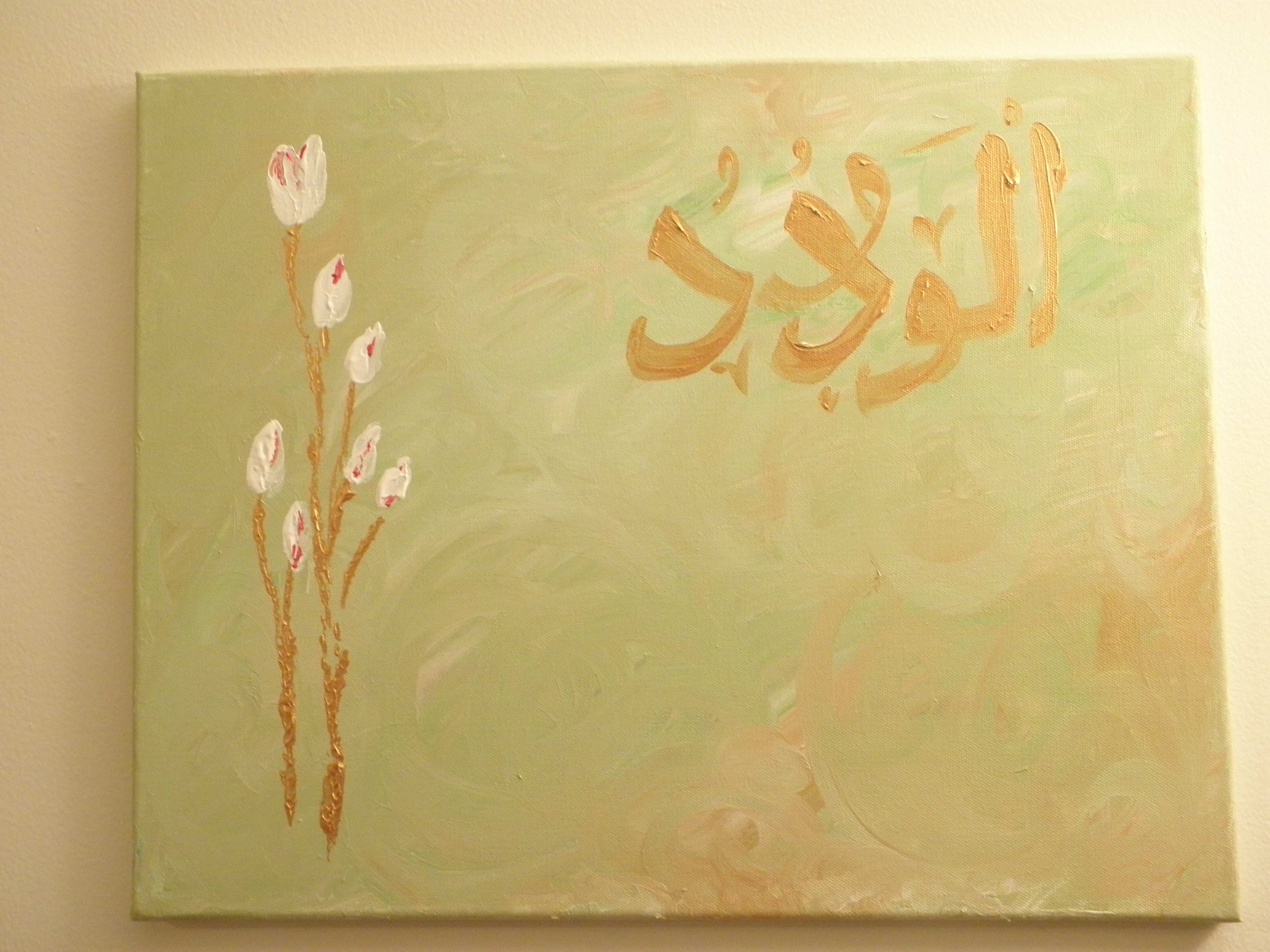
I have been thinking recently on this idea of attachment. That by attaching oneself to objects and things and even people, we feel emptiness inside when they are removed from us. Sr. Yasmin speaks of this a great deal. Love is indeed linked to this idea of attachment. And so it is possible to feel deep loss, hurt, pain when one does not feel a reciprocation of the love one gives out, be it to a lover, a relative, a friend. One solution to this, is to detach oneself. But I would disagree with this and say, yes do attach, do feel that deep love and show that. But don’t have expectations from those you give to. Keep your expectations only with Allah. Allah is the sole provider, nourisher, sustainer. Indeed Allah is ‘Al-Wadud’, ‘The Love’. Meaning God alone is the source of all love. So knowing this, when we are only channelled to recieve His devine mercy (Muslims often use the word mercy as a translation of ‘rahma‘, a core attribute of Allah, and one that also has the idea of love in it) and then transmit it, we don’t really expect a reciprocation from the entity we give it to. If at all we recieve something back we realize that person is only also chanelling to us a love from the same source! So we love our Lord more and in His name love those around us. But we do love, and love deeply. And we cry when we miss our loved ones. Even our prophet (peace and blessing of Allah be with him) himself teared when he would remember his first wife after her death. But we are not the slaves of those we love, but only the slave of ‘The Love’, so we know our source never dries up and therefore we are never alone and never need feel that level of heartache that is despair. Which is probably why our beloved prophet marvelled at the condition of a believer and said, “Wondrous are the believer’s affairs. For him there is good in all his affairs, and this is so only for the believer. When something pleasing happens to him, he is grateful, and that is good for him; and when something displeasing happens to him, he is patient, and that is good for him.” (Reported in the hadith collection of Muslim)
These are a few thoughts I wanted to share on the subject. And attached is an image of a painting completed with Allah’s majestic ‘name’ of ‘Al Wadud’, ‘The Love’. It was inspired at a time when I was the recipient of love mashaallah and was deeply in that emotion. So I am grateful for that inspiration and grateful for what I recieved. That too from my beloved glorious Lord!!! So celebrating Allah’s name, and sharing that, is attaching this image.
All good and all benefit is from Allah and Allah alone. So if any of you found anything good in this, that is by God’s grace and I am very humbled to be able to write and I do hope you find this beneficial for you.
May God’s light and peace be with you all
By God’s grace I am returning from a magical journey, a retreat you could say, to Vancouver Island. Being a girl who grew up on an island myself (even if it was half a world away!), there is always a special indescribable feeling I experience when I visit the island.
The journey has been magical for many reasons. InshaAllah I will share more of why soon. But since this is the first time I am blogging from my phone and more to the point since the ferry I am presently on is about ti dock(!), I will leave you with this picture taken of seagulls as they played catch with the ferry and danced with the wind. Brave and joyful souls! Birds remind me of the ayat in surah mulk
أَوَلَمْ يَرَوْا إِلَى الطَّيْرِ فَوْقَهُمْ صَافَّاتٍ وَيَقْبِضْنَ ۚ مَا يُمْسِكُهُنَّ إِلَّا الرَّحْمَٰنُ ۚ إِنَّهُ بِكُلِّ شَيْءٍ بَصِيرٌ
Transliteration
Awa lam yaraw ila attayrifawqahum saffatin wayaqbidna mayumsikuhunna illa arrahmanu innahubikulli shay-in baseer
Sahih International Translation
Do they not see the birds above them with wings outspread and [sometimes] folded in? None holds them [aloft] except the Most Merciful. Indeed He is, of all things, Seeing.
Quran (67:19)




 JoyManifest's Blog