Truly it is a beautiful call

Assalamu alaikum dear readers, peace be with you,

The moon is full tonight and it is a ‘supermoon’. Beautiful to behold, quietly radiant, softly white. And it marks the half of the month of Shawwal already passing. Time passes so quickly and how little control we have over time. Which reminds me of the hadith qudsi (narrations from the prophet peace be upon him, where the words are from the prophet though the message is from God, the exalted, the high. This is in difference to the Quran, where the words are from God, the exalted and the messenger peace be upon him, only transmits or utters them. And it is also different to the hadith literature – which are sayings of the blessed messenger himself and not the word of God, the exalted) that goes like this;

On the authority of Abu Hurayrah (may Allah be pleased with him), who said that the Messenger of Allah (peace and blessings of Allah be upon him) said:

“Allah said:

‘Sons of Adam inveigh against [the vicissitudes of] Time, and I am Time, in My hand is the night and the day.’” (1)


(1) Note from commentator – As the Almighty is the Ordainer of all things, to inveigh against misfortunes that are part of Time is tantamount to inveighing against Him.

It was related by al-Bukhari (also by Muslim).


And that milky bright moon, whose face beheld that of the blessed messenger…feasting my eyes upon its glorious super-moon splendour tonight, I thank God for the gift of eyesight and for the wondrous creation that is the moon and the sun’s light that it reflects. Isn’t it amazing that a great concentration of earth can become such a shining mirror! Subhahanalllah (=exalted is God)! Truly the methodology of the fashioning of the universe exudes the name of God – Al-Kareem (The Generous). And no generosity is akin to the generosity of the limitless divine. How little we understand of our Maker and how little we are able to in our created state. Subhahanallah.

To continue, feasting my eyes on the beauteous face of this bright pure moon, I echo the prayer our beloved messenger taught us to make, each time he saw the moon. He (peace be upon him) would say ” O moon, as you do worship God, so do I ” (I could not find the source for this narration, and it is my habit to usually give the source-text. However there is scholarly consensus that in certain matters – such as this quote, which is only meant to engender faith in the heart and can do no harm, it is okay to use even if the source is weak. Therefore I am not so worried about not finding the source for this one. Truly I can’t recall where I learnt it, I only remember reading it years ago and perhaps due to its simple joyous expression of faith – it was engraved in my memory). And I recall the numerous hadith from the companions of the blessed prophet (Gods’ pleasure be on them all) who all likened the beauty of Muhammed to that of the moon. I will give one here, and others are nicely compiled in this post

Jaber bin Sumrah (may Allah be pleased with him) said: “I saw Prophet Muhammad (peace be upon him) on a full-moon night.  His face was radiating with light, I looked at him and looked at the moon repeatedly.  His face was brighter than the moon”

(this hadith is in Imam Tirmidhi’s Shama’il)

Now it is strange, I titled this post on the call to prayer – the Azan. For I have come across a most beautiful azan that I want to share, and yet I am writing about the moon. But perhaps not so strange, for as the moon calls the waters of the oceans in tide-swell, so this azan calls the heart of all who listen to a heart-swell of peace. I pray you feel this peace, and so share this with you.

God bless you all

 

The miracle of water

Assalamu alaikum dear readers, peace be upon you all
Half of this blessed month has already left us, never to return, and one can’t help but be sad at that thought. But indeed then also still happy that the month is still in our midst and that the last ten days are soon to begin. Bi ithnillahi ta’ala (=with the permission of God, the Most High) I will blog about the last ten nights of Ramadan later on.

Many of my Muslim readers who have been fasting, and perhaps some of my non-Muslim friends who joined the fast this year, would have gotten a renewed appreciation for water the past few days. Here in Canada the days are long and where I live, we are having a spell of warm weather. There is nothing as delightful as that first sip of cool refreshing water at sunset when we break our fast. Indeed the du’a (=prayer/supplication) of the blessed beloved (peace of God be upon him) when he broke his fast is heartfelt by us as we also utter it. [He made other du’a when opening the fast, that we also say]

‘The thirst has gone and the veins are quenched, and reward is confirmed, if Allaah wills.’

While fasting has many esoteric benefits, one among them is  truly a deeper understanding of the suffering there is in the world. Some things just have to be felt to be understood! And yet, as I write this, I know it is true that the suffering of thirst and hunger we undergo is very different to that of people who really are suffering these tribulations. For we, we have some assurance in our heart of food and drink that will come at the end of the day. But for many thousands this is not an assured thing. Indeed this month reminds us that for many in the world, even in our post-modern context, starvation/malnourishment/lack of potable water is still a stark reality.

It is remarkable how much more energized I feel just after drinking that glass of water. It always strikes me how amazing it is, that this substance can bring about such a complete change in a matter of moments.

As a scientist-in-training I am mesmerized by water. It’s such a perfect molecule. I forget, but I recall reading that had not the bond angle between H-O-H (the two hydrogen atoms and the one oxygen atom) being the precise angle it is, all of life would not have existed. It is an amazing molecule – that when it is frozen, it weighs less than when liquid… one could go on and on about it.

So I looked up an old post that I want to share. It is taken from here. This was shared with us by one of my dear sisters, herself a post-doctoral fellow now mashaAllah (=by the grace of Allah). It was when we had been studying the water cycle as it is given in the Quran during our Quran study halaqa (=circle/group/class). It was blogged 4 years ago. A reminder of the 4th anniversary of our Quran study group and also of this blog, bi barakathiallah! (=by the blessing of Allah). A useful collection of ayaath (literally ‘signs’, meaning ‘verses’ in the Quran..as each verse is considered a sign of God)


“Also, since we were discussing the fact that Quran mentions that fresh and salt water do not mix. The reference to it is in the Surah 25 Al-Furqan: Ayat 53: “And it is He who has released [simultaneously] the two seas, one fresh and sweet and one salty and bitter, and He placed between them a barrier and prohibiting partition”

It is also in Surah 55 Ar-Rahman, Ayat 19 & 20.


I think we were all fascinated by water and how it sustains life.
Ayat 54 of Al Furqan is the one that says that humans are created from water: It is He Who has created man from water: then has He established relationships of lineage and marriage: for thy Lord has power (over all things). 

Surah 21 Al Anbiya Ayat 30: “We made from water every living thing”


I wanted to share this video (http://videos.howstuffworks.com/hsw/17265-the-water-cycle-where-fresh-water-comes-from-video.htm) about the cycle of water which is also mentioned in the Quran at several places:

– Surah 23 Al-Mumenoon Ayat 18: “And We send down water from the sky according to (due) measure, and We cause it to soak in the soil; and We certainly are able to drain it off (with ease).”

– Surah 30 Ar-Room Ayat 48: “It is Allah Who sends the Winds, and they raise the Clouds: then does He spread them in the sky as He wills, and break them into fragments, until thou seest rain-drops issue from the midst thereof: then when He has made them reach such of his servants as He wills behold, they do rejoice! “

– Surah 7 Al-Araf Ayat 57: “It is He Who sendeth the winds like heralds of glad tidings, going before His mercy: when they have carried the heavy-laden clouds, We drive them to a land that is dead, make rain to descend thereon, and produce every kind of harvest therewith: thus shall We raise up the dead: perchance ye may remember.”

– Surah 39 Az-Zumar Ayat 39: “Seest thou not that Allah sends down rain from the sky, and leads it through springs in the earth? Then He causes to grow, therewith, produce of various colours: then it withers; thou wilt see it grow yellow; then He makes it dry up and crumble away. Truly, in this, is a Message of remembrance to men of understanding.”

Let’s renew our appreciation of water, our thanks for it, and implement the sunnah (=way/habits/practices) of the beloved Messenger of God (peace be upon him) in how careful he was in using water and not wasting it.

Ramadan Kareem! (=May Ramadan be generous for you/wish you a generous Ramadan/God’s generosity be with you this Ramadan)


‘Fathima Knight in shining armour’!

Assalamu alaikum, peace be with you dear readers,

A few weeks ago, I was greatly delighted to ‘attend’ online, the first commencement ceremony of Zaytuna college. Zaytuna (=Olive/Olive tree) college is North America’s first academic Muslim liberal arts college. I believe it’s degree certification is from UC Berkeley. It was set-up by Sh. Hamza Yusuf Hanson, the scholar interviewed in the series I blogged recently.

I have been following the budding and growth of this institution keenly the past four years and it was  a proud moment to be able to witness its first commencement. The occasion was graced by Sheikh Abdullah Bin Bayyah, one of the few remaining ‘giant scholars’ in the Muslim world. He is a master of many spheres, speaks fluent French in addition to a very high caliber of Arabic and has a CV I have no words to describe, so I won’t. Suffice to say, that in his demenour and service he has come to embody what a true scholar is, and he is one of the teachers of Sh. Hamza. It is a great compliment to Zaytuna college that Sh. Bin Bayyah made the trip out for the commencement despite his 80+ years and difficulty with travel. He did it due to his heartfelt support of the endeavor. And indeed, it is a desperately needed endeavor. You may catch a glimpse of him in the clip, the elderly gentleman in traditional garb with his scholars turban. Knowledge has always been a prized possession for the Muslim, and God bless Sh. Hamza and his likes, who are fighting hard to bring back the light of learning to the Muslim world.

Faatimah Knight is a shining example of what a young person schooled in such an environment of sound knowledge and real scholarship can produce. Imam Zaid Shakir, is a well known and well beloved figure in the North American Muslim world. He is an African American ex-US marine (if I’m not mistaken) who converted to Islam several decades ago, and then schooled in traditional Islamic scholarship, who is now a teacher at Zaytuna. Imam Zaid mentions that whenever he sees Faatimah walking down the aisle, he calls out to her as ‘Fathima Knight in shining armour’. A compliment this young lady well deserves. This young lady is just that – someone inspiring for her truthfulness, sincerity and determination to follow her true heart.

I was so inspired and ‘taken’ by the depth and wisdom of her commencement address, delivered with such obvious sincerity that I wanted to share it with you. It is a 9.5 min clip. I hope you will be able to listen and be as inspired as I was. I pray for this young lady and may there be many more like her. She is well named by wise parents, after the daughter of the beloved Messenger of God, Fathima az Zahra (=the resplendent one… a title given to her by the people out of love. The world’s second oldest continuously running university, Al-Azhar in Cairo is actually named after her)

May God protect and increase this beautiful young lady. I am happy to note she has been offered a full scholarship to grad school in the illustrious University of Chicago Islamic studies program. I believe she refused a full scholarship for undergraduate study in U of Chicago to go to Zaytuna. She is one of the 14 students of the class of 2014. May God bless them all, their teachers and all who have supported this difficult and challenging endeavor.


Give30 , sadaqa, zakat and Happy Canada day

Dear Readers,

I was informed of this wonderful initiative by one of my brothers and wanted to highlight it here. Ramadan is a month of charity. Many of us save a lot of money on our grocery bill and entertainment/excursion bills etc., which is then given in charity. The hunger pangs and bouts of thirst we experience by fasting, doing their job of softening the heart so we renew our empathy with the majority of the world’s population still suffering from hunger and thirst. And we thank Allah SWT for this, for had it not been for this strong annual reminder, who knows who heedless/negligent we would be of other’s suffering.

Many Muslims give their ‘zakat’ during this month. Zakat is third pillar of Islam, one of the 5 obligations upon a Muslim. It literally means ‘purification’ and is an obligatory tax Muslims must give to poor Muslims/wayfarers/and a few other categories of people who qualify. 2.5% of a person’s wealth, if he or she meets the threshold to be ‘zakat-able’ must be given. The calculations can get quite complicated. This is due annually and it is up to the person to decide when to pay it. Almost all the Muslims I know, pay it during Ramadan though. One – because the fasting person is beloved to God, and any good deed done during this month is more beloved to God than at other times. And two – perhaps this experiencing of mock-poverty we feel does indeed propel us to give. Allah subhahanawa ta’ala a’lam (=God the most Exalted and High, knows best – we consign the knowledge of our comments whose truths we don’t know, to God most High and say He knows better than we do. So only He knows if my statement is valid or not)

Apart from zakat, any other charity is called sadaqa. Sadaqa comes from a root word that means ‘truth’. Giving charity does free one’s soul to experience truth, as indeed giving zakat ‘purifies’ one’s wealth. Ramadan is a month of exaggerated charity. The prophet, peace be upon him, was the most generous of men. But during Ramadan, his charity people said ‘was like the wind’. Allah elevate and bless him and his beloved family and make all his followers like him!

BTW the prophet peace be upon him, would fast excessively and was almost always hungry. They say people would not see smoke rise out of his chimney for 3 months at a stretch. His diet was mostly bread and dates. Though he loved meat, he (peace be upon him!) would never eat meat and bread together…considering it too much a luxury. But this does not mean, as some Muslims erroneously believe, that he (peace be upon him) was poor. There were periods of poverty, but for the most part he (peace be upon him) ruled a vary large state. His hunger was due to his extreme generosity and due to his frugal habits. In fact in our tradition, poverty – the real kind – is considered an oppression and completely disliked. We must fight to eradicate poverty in the world. But poverty that is voluntary, that is a different matter and may indeed be a safeguard from the traps of materialism. May Allah elevate the soul of our beloved and grant us the supreme felicity of meeting him.

Give30 is a remarkable effort. It’s a very Canadian story. And its a very Muslim story. It’s a Canadian Muslim story 🙂 – the kind I wish the news would cover more. But to be fair, they already have. I wanted to post it up on Canada day, but didn’t make it to do yesterday. However here is our brother who has been inspired by Ramadan, to organize the collection of money he saves by fasting so it may benefit local foodbanks. The blessed prophet said it was best to give charity locally. And though I know most of my Muslim brothers and sisters feel the strong pull to give to international organizations what with the horrendous global suffering contrasted to life in rich nation, still there is plenty of need here. So I hope you will share this initiative and promote it.


Website linked above and here it is again

www.give30.ca


Happy Canada day everyone and Ramadan kareem (=May Ramadan be generous for you!)

The honored guest has arrived! and my attempts to sight hilal ur-Ramadan

Assalamu alaikum, peace be with you!

My dear readers, Ramadan Mubarak! (= congratulations on Ramadan/wishing you a blessed Ramadan/Happy Ramadan…any of these will work, again its a phrase hard to translate). Thanks and praise to Allah for the felicity to meet another Ramadan. I pray you are all well and in good health to meet her, in happiness and ease.

Of the many things I am in love with in this way of life – deen ul-Islam (the religion or way of Islam) is the way our lives are tied to the natural phenomena. I love it that the five prescribed ritual worship cycles or salat (some call it prayer but prayer is what we do at anytime) are tied to the position of the sun in the sky. These are obligatory ritual acts of worship. The word ‘salat’ comes from a root that means to ‘do good’, ‘to align rightly’, ‘to recalibrate’. It has all these meanings. It is the daily 5-time reminder of who we are, where we came from, where we are going to, and who we belong to. It’s that one-on-one meeting of the slave with his or her Maker that is the most precious thing in the world.

And I love it that the way we count the months is tied to the phases of the moon. There is something very magical about the moon. And something more magical about how this moon and sun tie into each other. About the passage of day and night. About the light and dark. The Quran talks of these often in many many places. Again, I love these passages too much not to share, so here is one instance below. Where Allah SWT swears by these immense creations…and scholars of Quranic interpretation say, that whenever Allah SWT swears by something that is a mark of the greatness of that thing, and also a mark of the import of the message that is sworn upon – in this case, to have a pure upright character or soul or self.

These are the first 11 ayat (=signs) from surah Shams (=sun). Unfortunately the English does not capture the cadence, rhyme or rhythm of the Arabic. Also there is no ‘neuter’ gender in Arabic. Everything is either male or female.

بسم الله الرحمن الرحيم

In the name of Allah the most Loving, the One showing Love

91:1
By the Sun and his (glorious) splendour;
91:2
By the Moon as she follows him;
91:3
By the Day as it shows up (the Sun’s) glory;
91:4
 By the Night as it conceals it;
91:5
 By the Firmament and its (wonderful) structure;
91:6
 By the Earth and its (wide) expanse:
91:7
 By the Soul, and the proportion and order given to it;
91:8
And its enlightenment as to its wrong and its right;-
91:9
 Truly he succeeds that purifies her (meaning one’s soul)
91:10
And he fails that corrupts her (meaning one’s soul)!

Now the fact that it is the moon that determines the count of the months is significant also for religious reasons. Since the third main pillar of the deen is the obligatory fast during the month of Ramadan. So much has been said about this that I won’t repeat anything here, except to say briefly that during this month Muslims are obligated to fast from dawn to dusk. The fast entails keeping away from all usual pleasures – definitely of lawful eating, drinking and marital relations and also (though less strictly observed) of too much of the sensual pleasures such as movies, music, TV etc. even if lawful. It is a time one removes the ‘creature-pleasures’ to free the soul to experience divine realities. The spiritual masters say that a too satiated body is heavy on the soul and so cannot be tuned into the call of the Creator. So then, removing those creature comforts paves the way for those heart-valves to open. In addition to this there is exoteric cleansing of course and much charity and feeling for the poor is an outcome.

One of the results of this tying between the deen ul islam and the natural phenomena was the necessitated great feats in astronomy and mathematics that were part of the Islamic golden age. Precise calculation of time became increasingly more important as the Muslim world expanded. There is divine wisdom in action.

So I went out to see if I could sight the hilal ur Ramadan (=crescent of Ramadan). It is a magical experience. Something very special about seeing that new moon during the few minutes it appears before it sets close upon the heels of the sun. I was not blessed with that sight this month though, as it was too cloudy. But I caught a mesmerizingly beautiful sunset instead.

While some Muslims rely on astronomical tables to determine the month, other opinions favour the need to sight the moon with naked eye. Some scholars hold a local sighting is necessary and others say a global sighting suffices. Two witnesses are required. I was tracking crescentwatch.org that tells when there is a chance to see the moon (as in astronomical possibility) and tracks user sightings. I felt greatly elated to hear that the moon was sighted in Sydney that morning and so waited to see if I too would catch a glimpse of her that night. Being in Western Canada we were among the last to see her, except for Hawaii which would be much later. Also for my non-Muslim readers to know – for us, the ‘day’ begins with the night. So when the hilal ur Ramadan is sighted thus marks the first ‘day’ of Ramadan. Great joy then! as mosques began the special night prayers and people gather to celebrate this most special of special times.

May her stay with us this year bring much peace and tranquility to all people, especially in those Muslim lands torn apart by bloodshed and hatred. God have mercy upon us all.

Here is a screen capture from crescentwatch tracking the crescent’s march across the globe.

Image

And here is a image of the crescent announcement

Image

And finally the beautifully peaceful sunset I encountered, though I did not see the hilal ur-Ramadan

Image

A chat among scholars

Dear Readers,

I came across this ‘chat’ on youtube. It is an obviously an old recording. But it was delightful to me and I thought to share it. Why? because it is a chat between two of the greatest scholars of Islam, in the English language, today. Both these men (Allah ihfidhuma = Allah preserve them both) have had a great impact on my life. They are extremely well schooled in the classical or traditional Muslim scholarly tradition and both individuals who converted to Islam in the 70s (independent of each other).

A few words on the Muslim scholarly tradition. There is a well known hadith from the beloved Muhammed (peace be upon him). He is reported to have said

“Scholars are the inheritors of the prophets.” [Related byTirmidhi, Abu Dawud, Nasa’i, Ibn Maja, Ahmad, Ibn Hibban, and others] Ibn al-Mulaqqin, Zayla`i, Ibn Hajar, and others seemed it sound (hasan) or rigorously authentic (sahih)]

Please see here for a nice commentary on this hadith by another one of my beloved teachers, Sheikh Faraz Rabbani. Gems from there are

A sure sign of having this knowledge & inheritance is that one upholds excellence of character, as the Prophet (Allah bless him and give him peace) said, “The weightiest thing on the Scales on the Day of Judgment is good character.” [Abu Dawud] And he said, “The believers most perfect in faith are those best in character, and the best of you are those best to their spouses.” [Tirmidhi]

The best of good character is restraint and forbearance (hilm), for the Messenger of Allah (peace and blessings be upon him) said, “Forbearance (hilm) is the best of character.” The most beautiful of character and conduct was the character and conduct of the Beloved Messenger of Allah (peace & blessings be upon him & his folk).

True inheritors of the Prophet (Allah bless him and give him peace) reflect some of this excellence and beauty in their character and conduct. This character emanates from making Allah one’s true concern; being conscious of Allah; and true love for Allah.

What Islam uniquely brought (as per my limited knowledge) in the field of religious scholarly tradition is the ‘sanad’ system. Loosely translated as ‘chain’, the sanad is the living link between generations. In this system, knowledge is transmitted teacher to student, teacher to student and so on and on all the way up to the first teacher, the prophet of God, Muhammed (peace be upon him). For the westerner, the easiest way to understand it is the apprentice system. In the apprentice system, traditions are handed down generation to generation, without change and the knowledge is most authentic because the training of the student is not only in theory but in practice. In the context of an apprenticeship in ‘religious knowledge’, the student often lives with the teacher (or sheikh) and imbibes characteristics, mannerisms, ways of life that no book can hold. Students do not ‘graduate’ after a few years of study, nay, rather they are moulded over decades until they finally take their place as a full-fledged scholar. Usually this place is cemented upon the consensus of the populace. Being a trainee in scientific academia, I see so many parallels between that system and my own training. For example, how many a PhD student comes out of the long doctoral ‘apprenticeship’ imbibing their advisor’s method of thinking, writing, or  methodology of deducing arguments! Anyone who has been through this track will know what I mean.

So then an authentic scholar does have a sanad all the way to the prophet, peace be upon him. And so they really are inheritors of the prophets. The greatest catastrophe (as I’ve said often before, sorry for the repetition) upon the Muslim nation nowadays is the widespread dearth of such scholars. Worse, even the Muslim population is no longer able to distinguish a real scholar from a weak one or a poorly trained one, even from an imposter (and oh don’t we have plenty of those!). Once the population is unable to hold the scholarship to a high standard, then that results in poorer scholarship which leads to a more dummed-down population. It is a spiral downward.

This catastrophe is a result of the colonial period it is true, but still no point looking back and blaming others, it is time for us to revive authentic knowledge in our nation. Only so that we Muslims are aware of what happened, we should know, that there were scholars assassinated en masse in places like Turkey during the colonial era (targeted assasinations also took place in Iraq as recently as the American occupation of that country, not just of religious scholars but also of the secular academia – but this leads to another topic). There was also a systematic denigration of religious education in the minds of the common man by the colonial powers in the countries they ruled. I once listened to a well-researched talk on this from a visiting doctoral student from the USA. And indeed, I then could put two and two together and understand the poor estimation my own grandfather (Allah rest his soul) used to view the Ulema (=Muslim scholars) with. At the same time, their caliber was so poor that they were known for many lapses in good character and no honest person could admire them.  An example of that downward spiral.  That period was truly a colonization of the mind, for the remains of it still exist and many Muslims of today from those countries still reject religious scholarship. May God grant our hearts and minds are opened from this imperial domination and grant us sound scholars, as well as protect us from the sin of imposing such injustice upon another, no matter even if in our own home!

So here are two luminaries, both ‘signs’ of Allah :). An American convert from California and an English convert, who both independently journeyed, sought and found, and lived with authentic Muslim scholars and learned copiously as well as obtained license (=ijaza) to transmit Muslim scholarly works and who are now back in their respective homelands doing a great deal of good in spreading sound knowledge. My Muslim readers will know them well, for my non-Muslim readers – they are Sheikh Hamza Yusuf Hanson (who has founded the first Islamic seminary in the USA – at UC Berkeley) and Sheikh Abdul Hakim Murad or Tim Winter who is a professor of Islamic Studies at Cambridge University and is building a truly unique mosque/community center there. Apart from their very high caliber of Islamic scholarship, they are both masters of the English language, and as such are rare gems indeed.

Albeit their amazing stories, there conversation is more enjoyable. I felt this was a treat, so I hope you enjoy it too. I do believe one of the greatest lawful pleasures of life in this world is the gaining of sound beneficial knowledge (no matter the field) and being among the erudite. May God grant the latter pleasure in the hereafter as well!

BTW the Arabic word for discovery ‘kashf’ has a root that is shared by the word ‘ecstasy’! Indeed a true discovery is true ecstasy. I leave you then, to hopefully, experience some of that here.

May Allah preserve and increase them both and to you all the same!

Peace be with you all


Mezquita de Grenada

Dear readers,

Alhamdulillah (=praise and thanks to God) I am returned after completing a very educational and blessed tour of Andalusia. The tour was run by Andalucian routes, a company that offers tours of the ‘western Muslim world’ (as Morocco/Algeria/Tunisia/Islamic Spain used to be known) not just for pleasure, but with a definite educational slant. They also work with empowering ‘ghetto-ized’ Muslim youth in the UK, via teaching them their history. And they work to bring back to modern-day Europe, the spirit of co-existence and mutual respect between different faith groups that the Andalusian kingdoms of old Europe were famous for. So famous that a term was coined to describe this – ‘convivencia’. Check out Project Convivencia for more information on the work Andalucian routes staff do on this front. The tour was organized by the Swiss Muslim Events group and included by invitation, Sheikh Abdullah Hakim Quick, who is well known in western Muslim circles. One of the earliest western Muslim scholars, he has in addition to his formal Islamic knowledge training, a Masters and PhD from McGill University and specializing in History. He has made some fascinating documentaries on the old very rich (in wealth and knowledge) African kingdoms of Mali and Timbuktu. Here is a link to a short video on this topic. Do check them out, you may be quite surprised at what you find.

There are many special places we visited, in addition to the better known Alhambra and the Mezquita of Cordoba. And there were special people we got to meet, skilled artists and pure souls. What a blessing it is to be able to travel in this way. I pray you all also have these opportunities! For this post, I will only talk about a rather new place in Granada – a mosque that was built a few years ago. It is the main mosque in Granada, and called the Mezquita de Granada in Spanish.

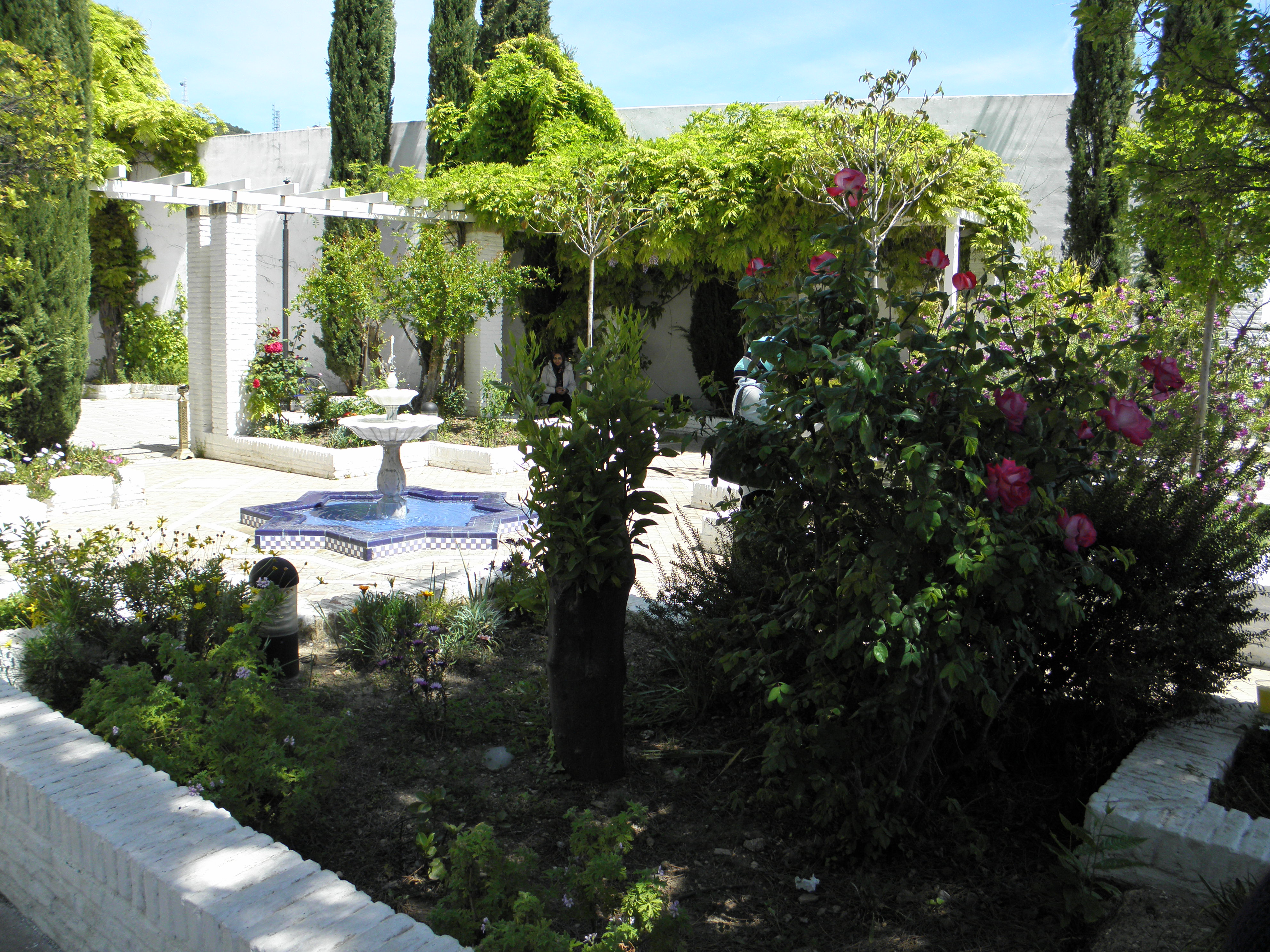
The Mezquita (easy to figure out that the Spanish word for Mosque comes from the Arabic ‘Masjid’) de Granada was built recently. It is on a hill that overlooks the Alhambra. It is built in the Moroccan style, which by no accident, is very much the Spanish style of building. In front of the masjid is a beautiful garden, with roses and jasmine and little fountains. Pictures below. The sound of the rippling water, the wind that blows the fragrance of the flowers as you sit in the welcome shade of the trees, and you feast your eyes on the flowers and yes, even the still resplendent walls of the Alhambra that evokes so much memory of history and of wise lessons of life.. and you wait for the Muazzin (=the person who makes the azan) to call the Azan (=call, the poem sung to inform the faithful it is time to pray) to prayer…what bliss! It was a piece of paradise. I made a video of the muazzin giving the call, I missed the first couple of lines. It is the first time I have heard the azan in this way, not through a loud-speaker. It must have always been like this in the past. It is very beautiful to hear the human voice wafting on the wind like this, sans technological input. No wonder the minarets (from where the muazzin makes the call) are high…the minaret on this mosque was not too high, yet I was surprised we could hear, though we were quite far away. Also I loved the style the azan was delivered in, distinctly European overtones I thought! I love this about the Azan, you will hear different styles (though the words and the language has never and will never change) depending on where in the world you are.

The garden is open to all, but the mosque is very small and can’t hold too many people, so it is not open to anyone except Muslims as yet. We were there on the Friday and got to participate in the Friday prayer. It was the first time I heard the khutbah in Spanish 🙂 (khutbah= literally meaning ‘speech’. the name of the two sermons given in place of two of the units of the noon prayer on Fridays. So we listen to the two sermons and then only offer 2 more units of prayer, thereby completing the prescribed 4 units of the noon prayer. There are guidelines of what a sermon should include and should not include in our tradition. Now that I am studying all of this, I sigh more thinking of how little the sermons I have sometimes heard in places like the subcontinent conform to this model. But I digress). It was a beautiful experience praying next to my Spanish brothers and sisters, many of whom can trace back their ancestors to Spanish Muslims who lived in Andalucía centuries ago.

Even more beautiful was to be able to attend the sunrise prayer there…walking up the hill in the night when it is darkest just before dawn, and then to sit in the quiet of the mosque. The Imam recited from Quran after finishing the offering of the prescribed short dawn prayer. He is a hafidh of Quran (one who has memorized the Quran. Hafidh is a beautiful word, it is translated as memorizer, but really it comes from the root word which means guardian or protector. And Al-Hafidh is one of the ‘names’ of God. It means then ‘The One of who protects’. And God is the ultimate and only real protector of all. But this is an example of the metaphysical meanings that Arabic is able to capture, as to memorize something denotes that one is then a protector and guardian of it). And he sat there and recited for a long time from memory. A young man, likely his student, was siting in front of him and reciting as well. I was following along with my mushaf (the actual written copy of the Quran) and not a single mistake could I detect in the recitation of the Imam, Al-hafidh al-Quran (=the hafidh of Quran. A title given to a memorizer of the Quran as Muslims greatly respect people who have done this). Allah ihfidhhu (= O Allah protect him!)

Here are some pictures of the ‘Mezquita’

The garden, facing the front of the masjid
A view of the Alhambra from the mosque garden
cool fountains and the sound of flowing water
The masjid, you can see the minaret where the muazzin gives the azan from in the distance
Children love to play with water!
The muazzin is ready to begin

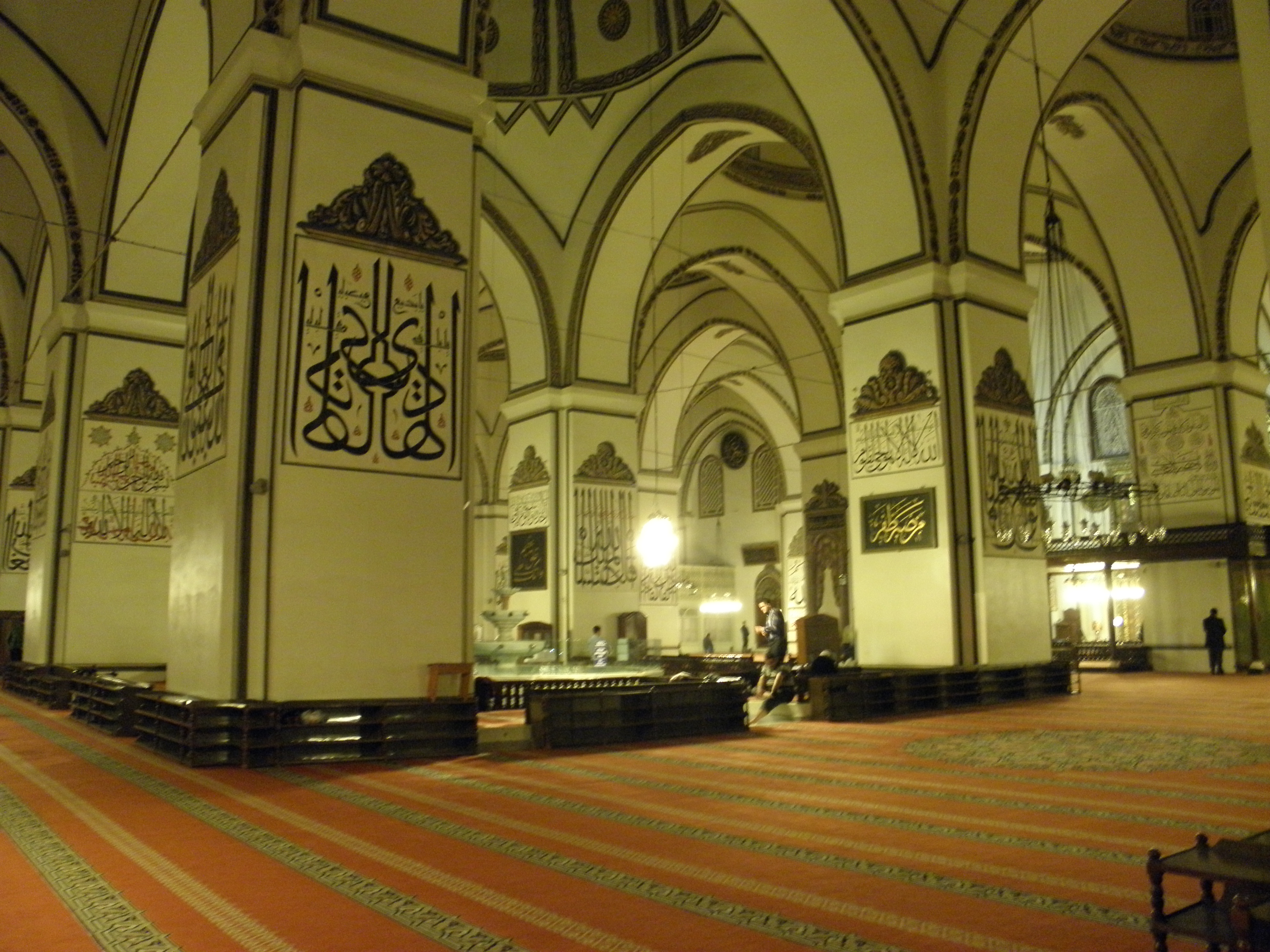
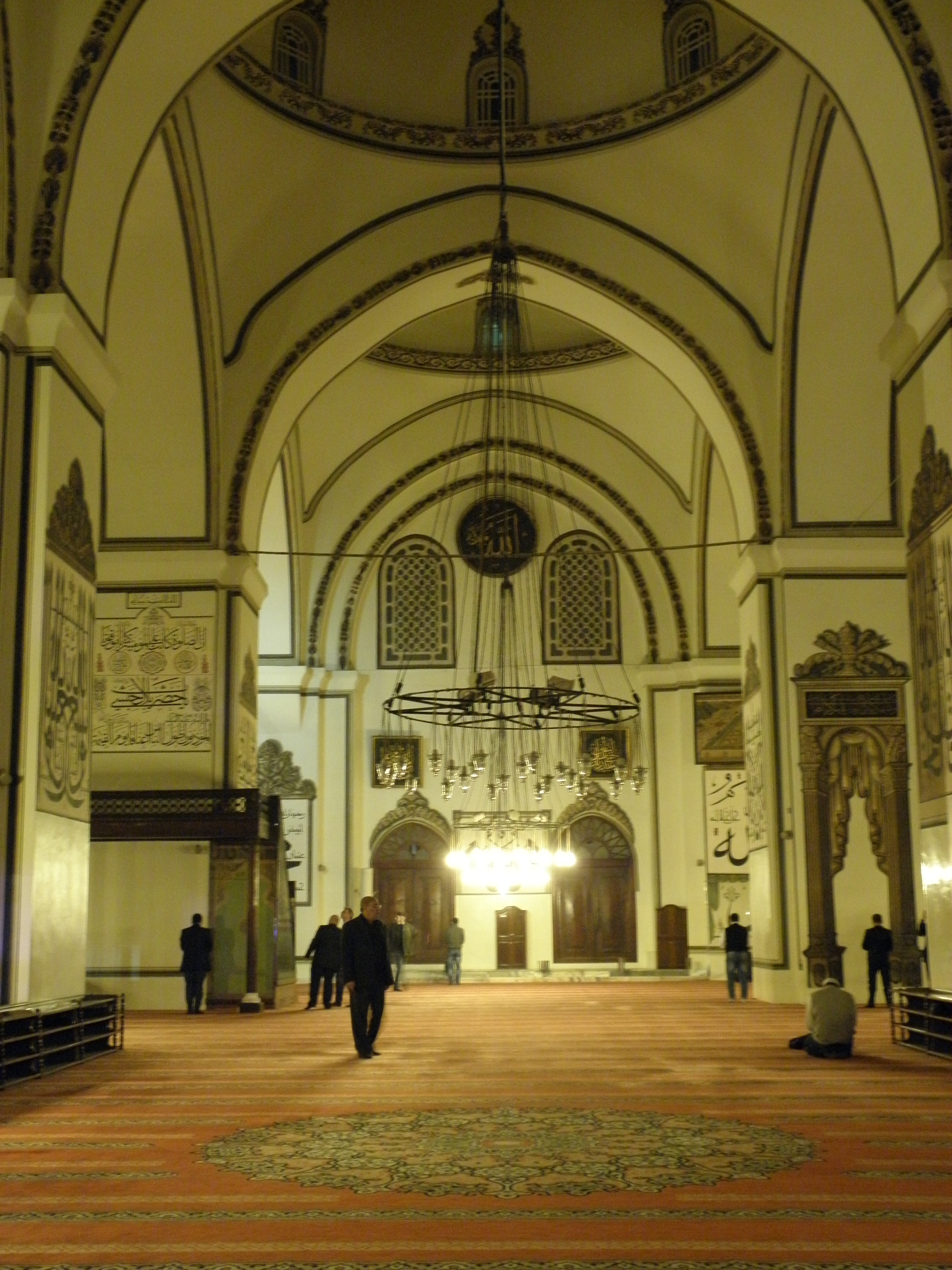
Ulu camii

Assalamu alaikum dear readers,

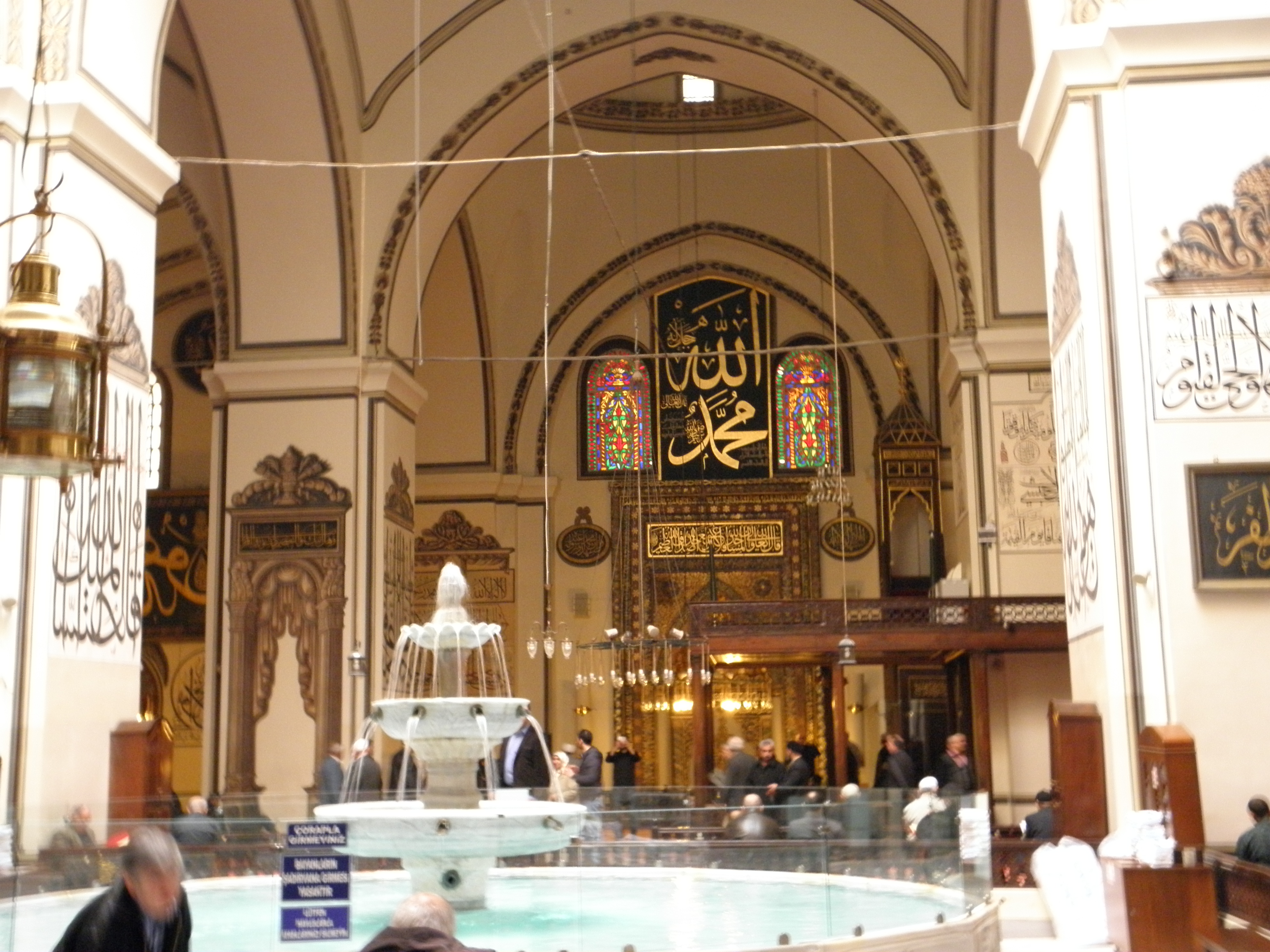
I have been wanting to write for a while but many unexpected things got in the way. I have much more to share about my rihla to Turkey, but the days are flying and new experiences are threatening to dull precious memories, as well as competing for blogging time and space (and I have been sternly denying them that). So I think this maybe the last post on Turkey. I chose for it a post about a very special camii we were blessed to visit. It is called the Ulu camii, also known as the Bursa Grand Mosque. It is an example of early Seljuk architecture and was built before the time when Constantinopole became the capital of the Empire, around the late 14th century. So it is from before the time of the great Mimar Sinan or the more famous mosques in Istanbul.

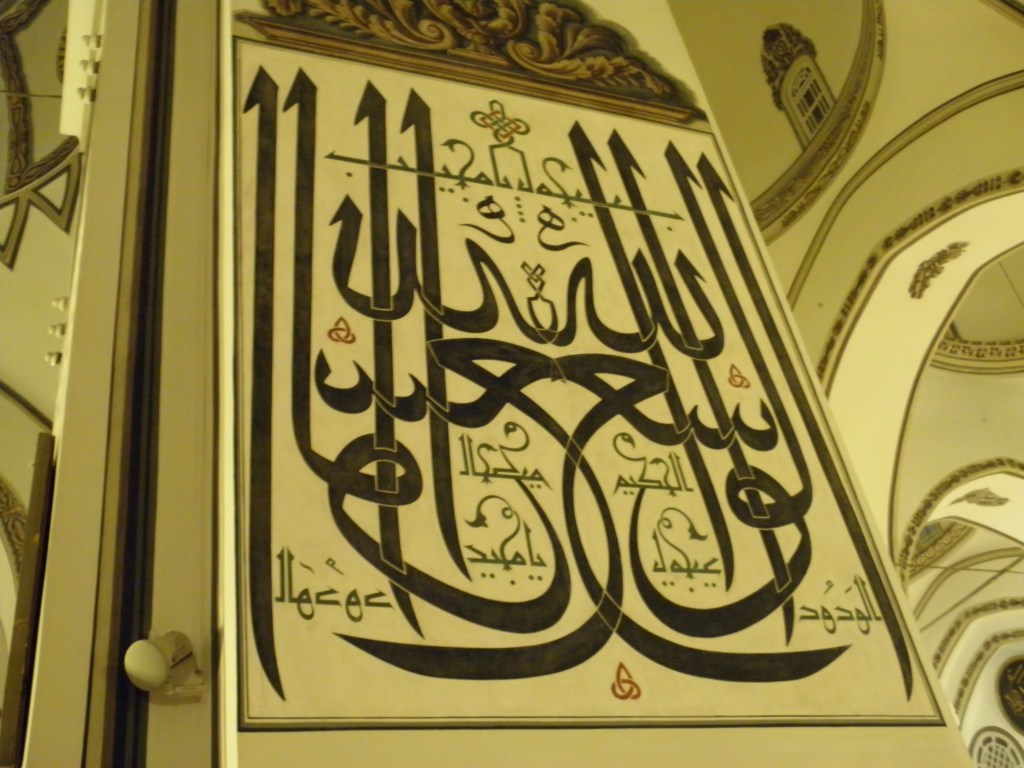
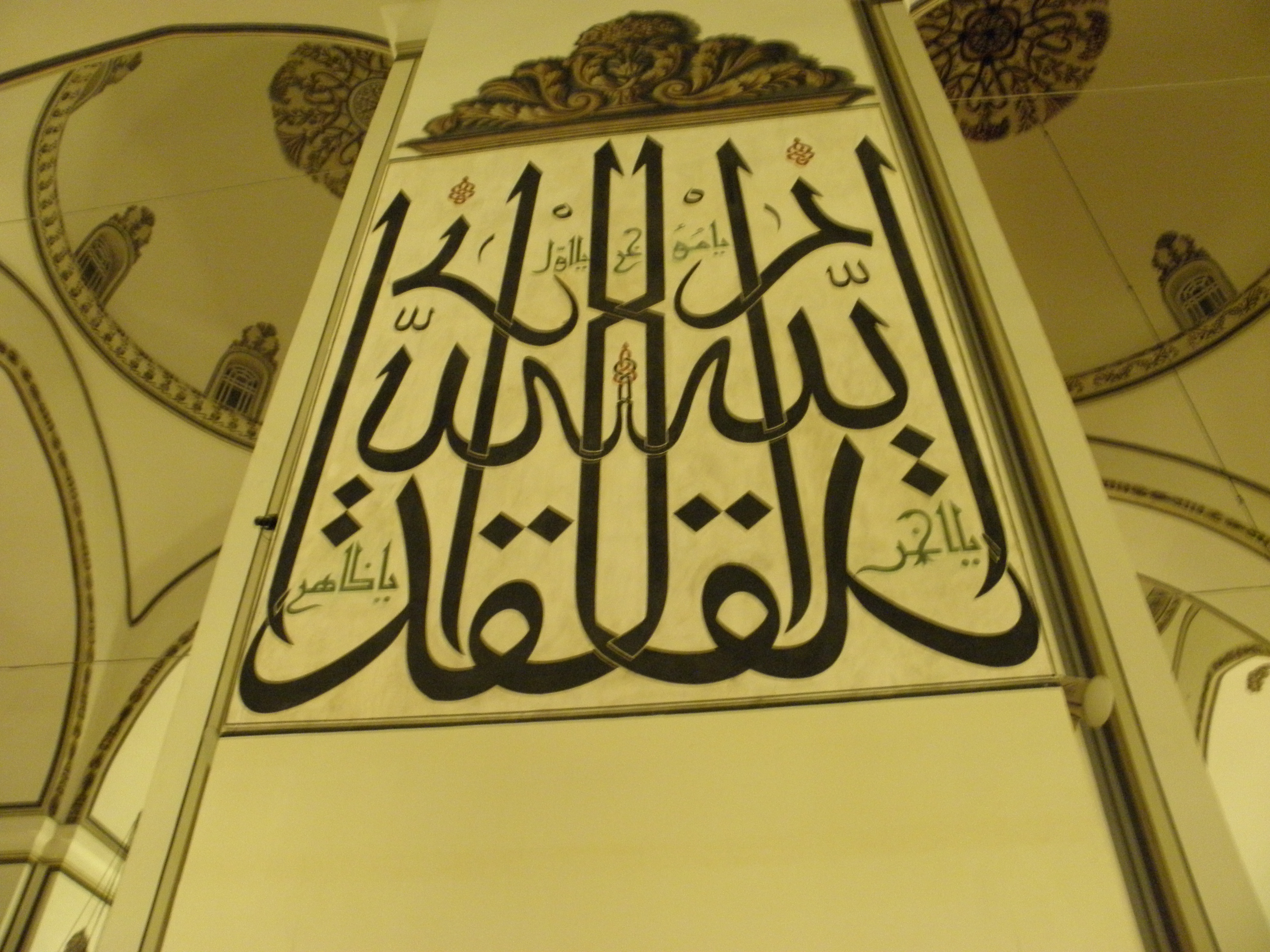
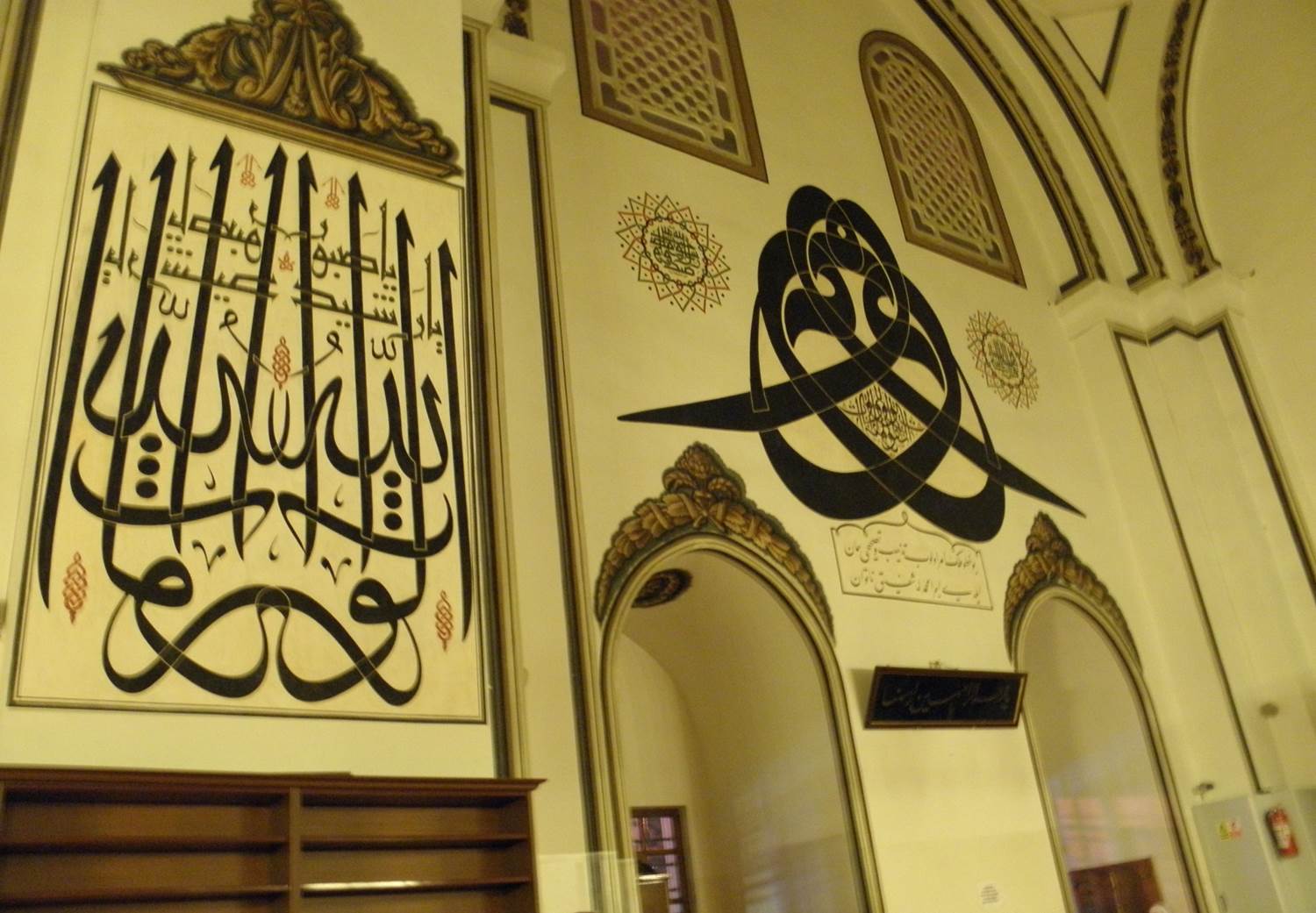
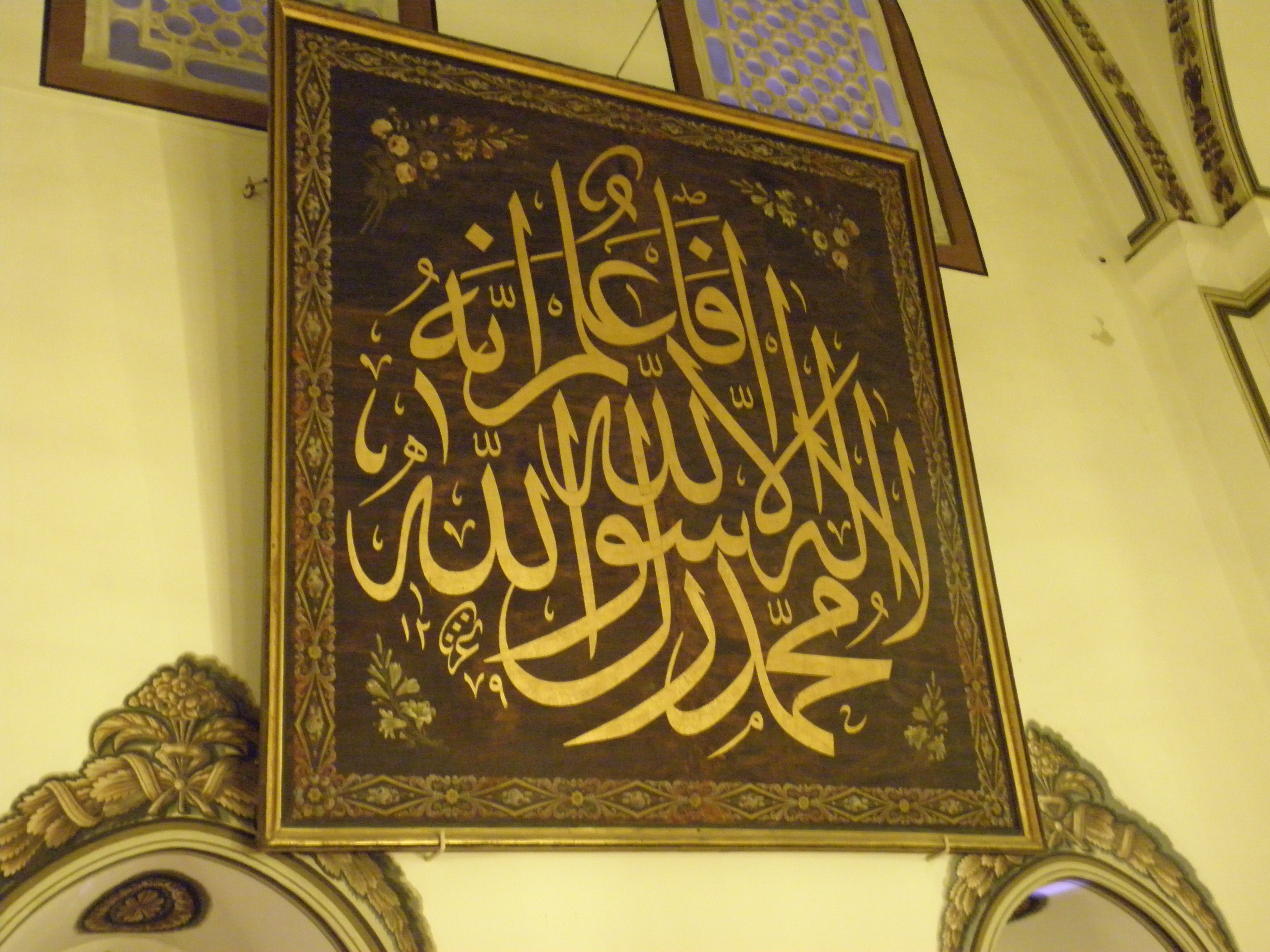
Why is this masjid (=mosque) special? Well, when you see the pictures you will know. We took a day trip down just to see it and were blessed to join the congregation for the noon, afternoon and sunset salah (respectively called ‘dhuhar’, ‘asr’ and ‘maghreb’) there before heading back to Istanbul. It is located in Bursa, a ski-station actually, a beautiful old city located high up in the mountains, overlooked by the towering Ulu-daag (Ulu mountain). The mosque unlike the later masajid (plural of masjid) is decorated in only two colours; black and gold. There is minimal tile work and ornamentation. But what it does have is considered by some as one of the most magnificent displays of Islamic calligraphy in one place. It has over 190 calligraphic panels and works painted on the walls of the mosque. Different verses of the Quran, Islamic phrases, saying of the prophet (peace be upon him). All done in a variety of the established classical styles of calligraphy. For those of you who don’t know, Islamic calligraphy has some classical styles and training in them is also handed down from teacher to student and follows the same ‘ijaza’ (=license) system of transmission. We were blessed to watch a master calligrapher at work, who has ijazaath (plural of ijaza) in I think all the major forms, and some forms took up to 13 years to master. Islamic calligraphy is very mathematical as most Islamic art forms are …unsurprising as Muslim science always considered math to be a language of knowing the divine…there are secrets of the Universe mathematical principles can unlock that no other science can. And I guess in today’s language quantum physics and allied sciences are what I would also consider pure mathematics. But I am going off on another tangent, so I better stop. Look at this interesting paper for a computer application developed to do what the old masters did by hand, exploring symmetry and how it teaches us meanings about origin and end… Here is more detail on the theory.

I believe there is a panel where in the corner the master calligrapher offers a challenge to anyone to better his work, and indeed he does sign some of the panels. The feeling engendered by these panels in the mosque is amazing, everywhere you turn there is some choice phrase or metaphysical symbolic composition of letters, it takes the soul on a journey that I can swear no visit to any Art gallery has ever done to me, and I can use the Arabic ‘wallahi’ to swear this! (Wallahi meaning ‘by Allah’ and it is not used lightly to swear on something)

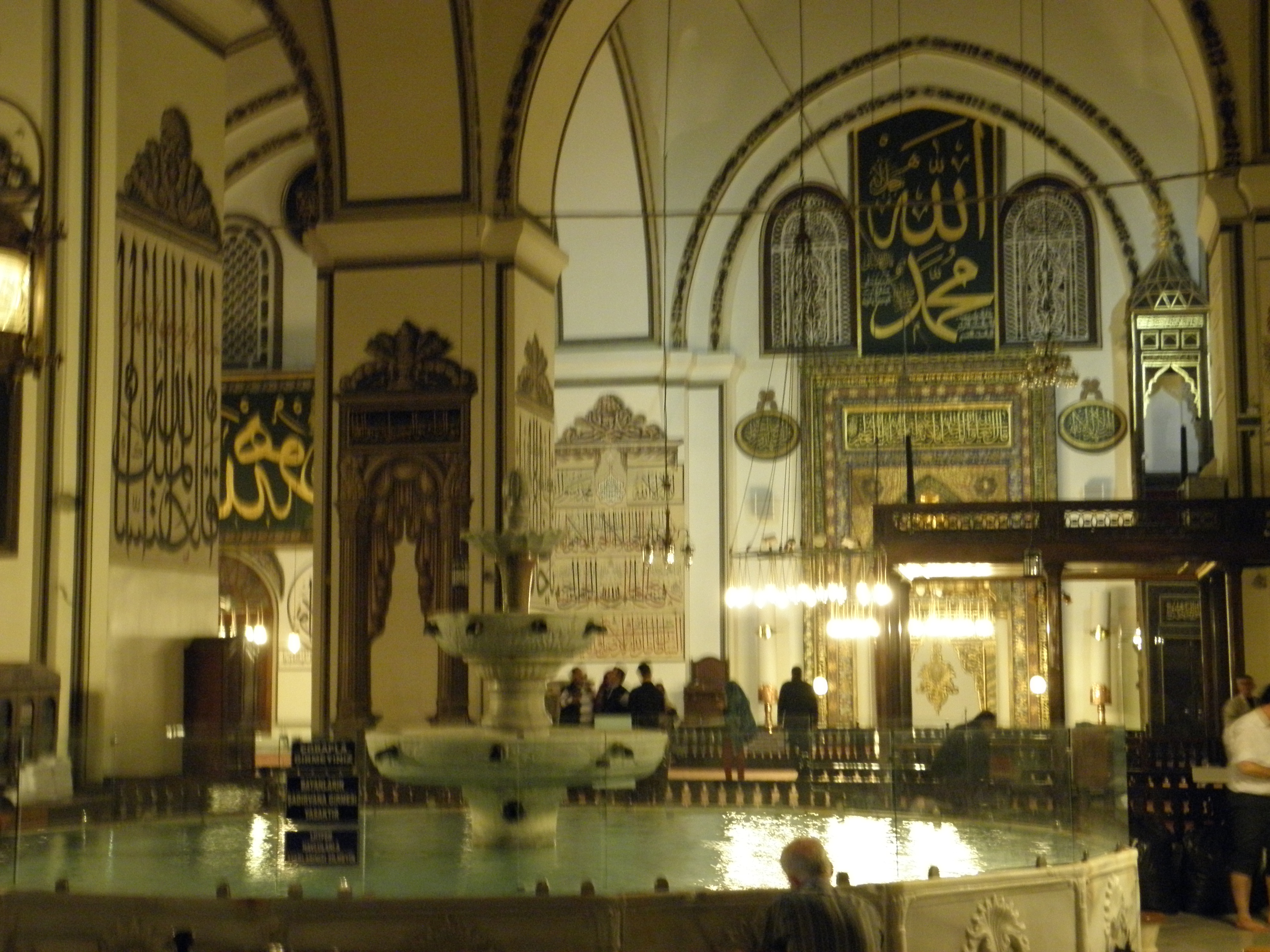
I will post pictures below. To leave you though, there is something very interesting in this masjid that I must share. Usually the place to take the compulsory washing one has to do before being able to enter the salah, called the ‘wudu’ in Arabic is outside. The wudu is often translated in English as ‘ablution’ and the idea is that one cleans ones external (the obligatory of this is to wash the hands and arms up to the elbows, the face, wipe over the hair and the feet. The prophet peace be upon him, would also wipe his ears and wash his mouth and nose so we often do that as additional and he would do this three times while reciting certain verses, so we follow his example, he also frequently brushed his teeth too) before one can enter the state of the ‘salah’ where Muslims believe we are standing directly in front of God which then is the time we go to clean our ‘internal’. Then before we go to the internal cleansing we undertake this external cleansing. So we can’t offer the salah unless we take our ‘wudu’ (certain acts nullify a wudu and then it has to be taken again, such as for example relieving oneself or falling asleep). However ‘ablution’ is a bad translation as it signifies the idea of prior sin, which is a concept foreign to the Muslim psyche. Rather the better translation I’ve heard recently is ‘lumination’ from an eminent English speaking Islamic scholar, Sheikh Hamza Yusuf Hanson, as the Arabic root word for ‘wudu’ comes from the same root as the latin ‘lumos’ (meaning gaining a state of light) comes from.

To continue the taps to take the wudu are usually located in the courtyard outside the masjid as we enter the masjid after having taken our wudu. But in the Ulu camii there is a beautiful fountain (complete with fresh clean towels!) located inside the mosque. This was an anomaly and we were curious why. The story goes, that when the Sultan wanted to build the masjid he began to acquire the land for it. All was okay except there was an old lady who lived in this small hut right in the middle of the proposed property who refused to sell to the Sultan. And it is a testament to his good rule that he could not compel her to sell her land. The story goes that eventually she died, and left no heirs. Now the Sultan went ahead and acquired the land and construction was to begin. However here is a dilemma, would the prayer of those worshipers who prayed on this land be valid, in that though acquired it was not done so with the permission of the owner. So according to Islamic law (and remember Islam as a religious tradition is most known in terms of its contributions in the field of law) the land may not be ‘halal’ (permissible) or valid, on which to build a mosque. The ‘ulema (=scholarly community) had a cunning compromise to this dilemma, they could not halt the Sultan from building the mosque but they could not rule that the prayer offered on this portion of the land would be valid according to Islamic law, so they couldn’t sanction it either. Therefore they proposed that a fountain be built on the section of land that used to belong to the old woman so that no worshiper’s head would touch the ground on what maybe a space where a prayer is unlawful. Instead people take their wudu there! I was humbled by this level of scrupulousness and earnestness in trying to find the best solution to a problem not to mention ensuring religious works are done according to the highest morality. And I could not but help think of the status of many Muslim governments of today who don’t care how they do what and would even murder their own citizens in the name of religion. May God help us all.

With that said, here are pictures. May peace be with you all and I will leave with this prayer that you too will get to visit places like this in the same way I have. And truly journey ‘through the earth to learn’

22:46
Sahih International Interpretation

So have they not traveled through the earth and have hearts by which to reason and ears by which to hear? For indeed, it is not eyes that are blinded, but blinded are the hearts which are within the breasts.

Quran 22:46
fountain
Ulu camiiOLYMPUS DIGITAL CAMERA OLYMPUS DIGITAL CAMERA Ulu camii alcove

OLYMPUS DIGITAL CAMERA OLYMPUS DIGITAL CAMERA OLYMPUS DIGITAL CAMERA OLYMPUS DIGITAL CAMERA OLYMPUS DIGITAL CAMERA OLYMPUS DIGITAL CAMERA


A Reflection on Divine Love

A masterful article by one of the luminaries of Muslim scholarship in the modern age. Please do read.

A Reflection on Divine Love.

Chess and Divine Decree

Assalamu alaikum (peace be with you)

My dear readers, I am not sure I’ve talked about it before, but those who know me know I am an avid chess player. I’ve loved the game since a dear uncle taught it to me before he passed away (Allah irhamu ‘may God bless and cherish his soul’. I was eight at the time I think…I still have the chess board he taught me on). It  is very relaxing believe it or not, as it focuses the mind and gives clarity to the thought. I used to play tournament level in high school and then at a rather mediocre college level but sadly have not had much opportunity to play since, except now online with a global chess community (you have to love the internet!).

So imagine then my absolute delight at finding this article on ‘chess and divine decree’. I always knew there was some deeper truth the game lead one to or hinted at…there must be, if it has the ability to draw people in so. It is a beautiful game, very profound. Quite surprising a game can be so.

But enough from me, please enjoy the article. One last parting thought on reading it, happy sighs to know our ‘Ummah’ (community or nation, a word Muslims use to talk about the followers of Muhammed, peace be upon them. The real and true followers, not charlatans and abusers of his pure and blessed name) had scholars of this caliber at one time, who could think and write so. May we once more have this level of scholarship in our community and in the world. I do believe peace comes with sound knowledge.

God bless you all!

Chess-and-Divine-Decree