Poems: Reflection / The White Deer

Brother Daniel Abdul Hayy Moore is a blessed poet indeed. On reading the below, I am honored to be able to reblog it. Especial thanks to him for sharing the deep piece on ‘tafakkur’ = reflection, written by Sheikh Muhammed ibn al-Habib (raheemahullah alai, May Allah bless him with His mercy)

danielabdalhayymoore's avatarEcstatic Exchange / Poetry of Daniel Abdal-Hayy Moore

white deer

(Note: I’ve been invited to present a series of eight sessions on poetry, I’m calling The Ecstatic Exchange Seminars on Poetry: Intuitions & Enthusiasms. As a foundational text, I’m using this song from the Diwan of Shaykh ibn al-Habib (raheemullah), which has struck me as being, as well as an all-encompassing directive toward sublimest gnosis, a wonderful Ars Poetica for creative contemplation and heart’s action, as well as writing devotional poetry, or poetry of any kind… )

REFLECTION

Tafakkur
by Shaykh Muhammad ibn al-Habib
(may Allah be pleased with him)

Reflect upon the beauty of His artistry on land and sea
And journey through God’s attributes both obvious and hidden

The greatest signs of God’s limitless perfections are found
Within our souls and on the horizons spread across the world

Contemplate all physical forms and behold their structural beauties
In exquisite order like pearls threaded on a string

View original post 1,148 more words

Boston

I wanted to say this myself…was so angered by the news all I could manage was some verse which I will later post. But this is said so well by Imam Zaid Shakir that I am reblogging. Thanks to Paul for posting it

‘I am nothing….without you’

This song from Sami Yusuf’s latest album, which if you can I urge you to buy, not only to benefit a great artist, but because also music like that which he makes purifies the heart. This song touches me deeply. Brings a tear to my eye, melts away all the pain…

I have always believed and felt that music is a great way to know God. Somehow it breaks down barriers and seems to penetrate the heart. What a metaphor! like sound can travel through walls, so can music travel through whatever stubborn walls we put up around our hearts that prevents us seeing our Maker. Prevents us knowing our home, knowing our Lord.

It is called ‘Dryer Land’ sung by two great maestros of music, they may be father and son, I am not sure. You can purchase the album here

This is the official youtube. The lyrics to the part in Farsi is especially transcendent.

God bless you and on you all be peace. Assalamu alaikum


Moons outshine stars

Moons outshine stars

And the sun outshines them all

I stay awake at night

and in the days am bathed

by light upon light

in the night, am enveloped

with cool breezes of mercy


Closeness with my Beloved

fills my heart and all other pales

as it should

for ‘truth stands clear from error

and whoever has grasped the handhold of God

knows that it will never break’

– Copyright Joymanifest.com (C) 2013

***

A little verse I wanted to share, there is truly no tranquility except the tranquility of knowing one’s Lord and being at one with THE ONE. The last lines are derived from one of the most celebrated verses in the holy Quran given below. Thought I’d post it up. May it lighten your day and bring you closer to the source.

Peace to all. Assalamu alaikum

2:256
Yusuf Ali Interpretation

Let there be no compulsion in religion: Truth stands out clear from Error: whoever rejects evil and believes in Allah hath grasped the most trustworthy hand-hold, that never breaks. And Allah heareth and knoweth all things.

 
Quran (2:256)
 

Renew, awake…like the dead seed brought to life, sprout and grow

Alhamdulillah (praise and thanks to God) spring time is here again! Once more to be blessed with life to witness the blossoming of the cherry trees, to listen to the birds returning, to feel the sweet sun on one’s skin and to walk with bear feet over soft grass. God’s blessings are everywhere and surround us always, how often though our distractions take our attention away from the signs all around. So thanks to my Creator, the One, who does not sleep, does not tire, does not die, without beginning and without end, who looks after me. So thanks and praise to my Creator from whom I came and to whom I will return.

I was reading tonight some ayaath in the Quran, that talked about the sprouting of the seed. You know this whole idea of the seeds….they used to fascinate me as a teenager and they still do. How is it that the seed does sprout? If any botanist out there knows please let me know. I am a geneticist and I know we still don’t fully understand how a single cell divides. What fascinates me is the concept of dormancy and then to have life. I mean from a pure biological sense (nevermind the metaphysical, though that too is something to talk about indeed!). I wonder how DNA, which is the cellular ‘mission control’ or ‘code’ but really its just a massive chemical…how does it suddenly start up, how does a cell stay in a suspended state without cellular death… I could go on for a long long time with one question after another, but enough now. This is a train of thought that won’t end easily 🙂 Well, I guess my Lord guided me right in making me a scientist, one would need a lifetime to figure out why. Or rather several lifetimes of several people. And so hoping to add my small contributions to those of so many who have passed before. And all and only for the pleasure of the Creator, who loves to be known. And indeed studying His immaculate creation is mesmerizing. We have a philosophy in our tradition; that we study the creation to know the Creator. This is what the Quran constantly enjoins..’think’/’ponder’/’read’/’observe’…and what countless great scientists of the Islamic world have been upon for centuries inspired by that message. I heard a well known scholar say that the Arabic word for ‘discovery’ is the same as ‘ecstasy’. A huge grin on hearing that, for indeed a true discovery (nevermind what it is about) is truly ecstasy! I think this is because a true discovery brings one insight about the Maker, and how can the heart but delight in moving closer to the Beloved. And God knows best.

With that happy sharing out of thoughts with you my dear reader, I leave you with these beautiful verses from the Quran, only wish I could also share a recording of their recitation…for it is amazingly powerful yet amazingly peaceful. The English translation (or interpretation, the Quran really cannot be translated in the pure sense of the word ‘translation’) I have chosen is from the early 20th century Yusuf Ali translation, as the English used by him comes closest in my opinion to capturing something of the poetic beauty of the Arabic. Though of course, rhythm and rhyme are completely not there.


6:95
It is Allah Who causeth the seed-grain and the date-stone to split and sprout. He causeth the living to issue from the dead, and He is the one to cause the dead to issue from the living. That is Allah: then how are ye deluded away from the truth?
 
6:96
He it is that cleaveth the day-break (from the dark): He makes the night for rest and tranquillity, and the sun and moon for the reckoning (of time): Such is the judgment and ordering of (Him), the Exalted in Power, the Omniscient.
 
6:97
It is He Who maketh the stars (as beacons) for you, that ye may guide yourselves, with their help, through the dark spaces of land and sea: We detail Our signs for people who know.
 
6:98
It is He Who hath produced you from a single person: here is a place of sojourn and a place of departure: We detail Our signs for people who understand.
 
6:99
It is He Who sendeth down rain from the skies: with it We produce vegetation of all kinds: from some We produce green (crops), out of which We produce grain, heaped up (at harvest); out of the date-palm and its sheaths (or spathes) (come) clusters of dates hanging low and near: and (then there are) gardens of grapes, and olives, and pomegranates, each similar (in kind) yet different (in variety): when they begin to bear fruit, feast your eyes with the fruit and the ripeness thereof. Behold! in these things there are signs for people who believe.
 
Quran (6:95-99)
 
With that, peace be with you all, may you be in internal and external peace…there is so much strife spreading in the world.. so this greeting, Assalamu alaikum (‘peace be to you’ how the Quran instructs us to greet people, it is used to take leave as well) to you is a prayer as well.
 
Image

Muslims in America – a useful conversation

Assalaamu alaikum (peace be upon you)

I came across this on youtube and wanted to share it. It is refreshing to see an honest open conversation held in this way, where people are able to ask what is on their mind and in turn hear everyday Muslims answer.

Having said and shared, wanted also to share that I am currently blessed to be in the middle of the Canadian rockies, in Banff, Alberta. It is a dream come true for me. I have always wanted to visit the rockies since I was a little girl growing up in a tropical island halfway around the world, for some odd reason, hooked on to John Denver’s timeless music (lyrics mostly 🙂 )
God has indeed blessed me in ways I could never have imagined and my being here is testament to that. Alhamdulillah (all thanks and praise be to God)
InshaAllah (God willing) more from this trip later.

Below is the clip, hope you get to listen.

The search for a living Islam

Assalamu alaikum, peace to all!

It’s been way too long since I last posted. I’ve missed sharing as I do via this medium. I am stuck in the middle of moving house and as anyone who has done this knows, it is not pleasant nor does it leave much room for other pursuits. That and family issues that I would like to ask for your prayers for. So inshaAllah I will get back to regular posts once things settle down. In the meantime I wanted to share this excellent article a dear friend and mentor shared on her FB site. Anyone who spends even a little time in contemplation, can realize the globe is going through a period of intense change and that the Muslim nation if not all of humanity is being challenged to self-examine and self-correct…

May the below be fruitful reading!

An article published by emel.com discussed the issue of how we have become “informed yet ignoramus”. Written by Sheik Abu Muntaser, the Chief Executive of JIMAS.org, “The search for a living Islam” provides an account about how life has an orientation and moves towards a certain end. In the midst of that, we tend to forget about the Day of Judgment.

The Messenger of God (peace & blessings of God be upon him) said, “I have been sent in order to perfect moral virtues (in you).” As I slip into my waning years of life and look back at all the adventures and misadventures I have been privileged to savour, I realize just how centrally important this narration is to appreciate our short sojourn on this sweet and verdant earth.

As Muslims we are meant to be an example for people on how to live well by teaching them how to measure their days. We understand life has an orientation and everything is moving towards a certain end. After a few numbered days followed by the mysterious existence in an afterlife waiting for the great resurrection there is a grand Day of Judgment. We are all then separated into those who have succeeded and those who have not. What we bury in our hearts is thus important. To bury something does not mean it is dead. Hate, grudge, envy, jealousy, anger, greed, lust and pride in our hearts consume us from within and the devoured soul will have very little to be saved on that portentous day. These destructive elements always spring to life through the stimulants of negative experiences unless we have learnt to kill and wipe them out of our hearts.

Look behind the cause of sins in our lives and we are sure to find one or more of these characteristics of hate, grudge, envy, jealousy, anger, greed, lust and pride. When such peculiarities fester we are in reality enslaved to our desires. It is then that our lives are taken over by them and we overlook what our scholars summarized: the way we treat the servants of God, we will be treated by God the same way.

The blessing of pure monotheism in our hearts produces mercy towards creation. As the Quran reminds us, “Then will he be of those who believe, and enjoin patience, and enjoin deeds of kindness and compassion.” (90:16)

Forgetting this simple principle of Islam is at the root of our delusion that we are champions and defenders of faith while yet beholden to the vain desires. We talk about various deceptions; deceptions of glamour, of nuclear energy, of power or even of global capitalism, but hardly any of us care to mention deceptions of the self. Self-deception is about keeping secret from ourselves the truth we cannot face. Make no mistake: the media advertises something in between the commercials. How are we then affected considering we are always so focused on correcting others but ourselves?

“And do not follow that of which you have no knowledge; surely the hearing and the sight and the heart, all of these, shall be questioned about that.” (17: 36) Our rich heritage of exegetical material makes it clear that this verse forbids passing judgments without knowledge, false accusation, bearing false witness and speaking based on conjecture.

We become busy for Islam and her people while in reality we do not see how we merely scramble to achieve an enviable image to display to others. Busyness acts to repress our inner fears and personal anxieties but worryingly, propaganda replaces intelligent thought and time becomes opportunities to avoid responsibilities, whether of learning, teaching or performing actions that build and benefit. We rhapsodize about the joy of sacrifice and striving but do not see how we become the first ones least obliged towards such. We become mired in moral laziness because we do not understand the work of the heart.

As the saying goes, “Nothing is foolproof to a sufficiently talented fool.” This is something to note so that we do not become the ‘informed ignoramus’ among us who speak about Islam without due knowledge.

Learning what to feel is one of the hardest aspects of moral education. One can know a fact and know how to act, but to know what to do; it has to come from the right motivation, whose seat is the heart – it is a feeling. When the heart does not distinguish between good and bad, there is loss of total faith. Knowing what to feel is thus the essence of educating the emotions and virtue is learnt by that.

Truthfulness, which is a necessary prerequisite, is no more than a condition of the heart. It should be there when we speak and act. How does the heart feel at such time? Do we sense serenity and feel calmness in our hearts?

Do we perhaps confuse reactions with truthful action? Motivation and sincerity are not the issues. The real issue is whether we spend adequate time in serious, purposeful, peaceful and deep study, instead of simply reacting. By reacting in the name of Islam we only live to learn later through regret and shame, the harms and pain we thus either cause or never manage to remove, despite the best of intentions.

Much of our actions are needlessly debatable when there are many safer and surer options available to face the challenges that face us. Maybe we are too impatient and impulsively thrust forward with the irrational excuse that doing something is better than doing nothing because we really only want to follow our desires.

We are fools to repress our hearts into hardness through reactions of whim and temper when we have a serious duty to bring about peacefulness through truthful action. Just as truthful behavior is tranquility in the heart, so is goodness or good behavior.

For the heart to open the treasure chest of wisdom, it must address knowledge with humility. Ali had once said, “Do not recognize the truth through men, but recognize the truth and thereby recognize its partisans.” When knowledge of Islam is received with humility it opens doors to recognizing the truth, then to understand one’s own inadequacies and requirements for care and appreciation of the sacred duty to absorb and grow in that knowledge.

The Messenger of God said, “Every religion has a certain ethos of its own and the ethos of Islam is al-Haya (modesty).” We know that Adam was not taken out of Paradise in order for it to be given to others besides human beings. When Adam found his way back to God what was it due to? Was it due to his glory since the angels bowed to him? Was it due to his honor since he was taught the names of all things? Was it because of his dignity since God fashioned him with His own hands? Was it due to his pride since God breathed into him his spirit? He got back to God simply due to humility! The Quran reminds us that they said: “Our Lord! We have wronged our own souls: if you forgive us not and bestow not upon us your Mercy, we shall certainly be lost.” (7:23)

Fire outside the fireplace is dangerous; a fireplace without fire is useless. Islam has a form and content. The fire is action and the fireplace is the framework of Islam’s obligations and limits. The form and content of the faith work in harmony and fortify each other. The noble behavior of the Messenger was the pure form; the fire. The revelation constitutes the sublime content, the fireplace.

Islam offers the watching world its best when the outward and the inward, the form and the content, the action and God’s revelation embrace. Islam is a choice for people. When we offer a better and more humane society-the form; with a content that does not lack in any room for the spirit to soar towards God, we are then sincerely on the road to success.

The Messenger of God said, “The parable of the believer is that of a bee; what it eats is good, and what it produces is good.” Our true care for the ‘Lived Islam’ leaves us no time for an ‘Imagined Islam’. To people who live Islam, God is never a source of validation for their wicked ways but a Lord for their moral elevation.

As mentioned by His Eminence, Sayyed Muhammad Hussein Fadlullah (ra): Reckoning approaches man to the extent that he will come across it in every moment that draws him nearer to death, for death signifies transition from the realm of deeds, this world, to the realm of reckoning, the Hereafter, as Imam Ali (a.s.) put it down in his famous saying: “Today is the time of deeds and not reckoning, and tomorrow (in the Hereafter) is the time for reckoning and not for deeds.” The Quran has notified man on many occasions about what is awaiting him after death, as in Allah’s saying: “And return to your Lord time after time and submit to Him before there comes to you the punishment, then you shall not be helped.And follow the best that has been revealed to you from your Lord before there comes to you the punishment all of a sudden while you do not even perceive.” (39:54-55). The Quran expresses death by punishment, noting that punishment is the fate of the extravagant sinners who did not repent to Allah before their death.

Thus, reckoning approaches people as they get closer to the Hereafter without determining its exact time; is it right after death as some narrations talked about punishment in the grave or is it on the day of resurrection; the day people resurrect before Allah. The main issue is to bring up the concept of reckoning in their hearts and minds, “yet they heed not and they turn away”, for they experienced heedlessness to the fullest by avoiding the truth obstructed by many barriers; thus, they would turn away from every call for the right, for they are not aware of and open to it.

Some wonder about the reason for joining between heedlessness that suggests inattentiveness and turning away that represents a voluntary (aware) negative stand. The answer is that turning away signifies a realistic negative state that could be aware of the stand or heedless, for it represents the actual negligence of the movement of responsibility in his life, and Allah knows best.

Allah also says: “There comes not to them a new reminder from their Lord but they hear it while they play,” meaning that they do not shoulder their responsibilities seriously; but rather, they face them playfully, as if messing up with their fate and neglecting the negative repercussions awaiting them. This is was the prevalent state at the time the prophets brought the messages of their Lord to guide them to the straight path, grant them success and make them feel the spiritual ascension that brings them closer to Allah; thus, clarifying many realistic problems they face in the intellectual, political and emotional issues. They used to listen to the prophets frivolously not wanting to engage their minds in what they were listening to or nurture their souls on it or experience the suffering through it. All they wanted was to respond to their feelings and fill their leisure time, not caring about what they hear, but just listening to the echoes caused by the words, away from their connotations, and creating sarcastic ambiences through the opposing stand they make.

‘What the world needs now is Love, sweet Love’

Assalamu alaikum warahmatullah (peace be on you and the loving compassion of God)

The talk I want to share here is by a great luminary in our tradition, a direct descendant of our beloved prophet;s (peace be upon him) couzin, Ali (Allah be pleased with him), Sh. Habib Ali Jiffry comes from a long line of scholars and can trace his ‘isnad’ (chain), I believe it’s called, a very long way..I think all the way to Muhammed (peace and blessings of Allah be upon him). You see in traditional or classical Muslim scholarship, a scholar ‘graduates’ to be able to teach by obtaining ‘ijaza’ which is basically a ‘license’ to teach, from his teacher. And traditional Muslim scholarship is taught one-to-one, with often the student living with his teacher to observe the teacher’s characteristics, behaviours, manners etc. which together we use the arabic term ‘adab’ to denote. So really good Muslim scholars can trace their scholarly chain of transmission back a very long way and the more luminaries one recognizes in the ‘isnad’ the more one realizes the worth or the caliber of that particular scholar. You can read more about Sheikh Habib Ali Jiffry here (well worth clicking on this link, it will give you a taste for what authentic Muslim scholars are about). One thing I want to point out from Sh. Habib’s isnad is his noted taking of knowledge from female scholars, something apparently quite common in our tradition before but for some reason not understood in the mainstream today. In fact, one of the greatest scholars of all time in the Muslim tradition, is Ayesha, our beloved mother, the prophet’s wife (may Allah be pleased with her). She taught many men and women for years from all over the Muslim world and she is a source of much of our scholarly material.

Having said all the above, the talk itself was delivered at RIS last year. RIS stands for ‘Reviving the Islamic Spirit’, it is a twice annual conference held in Toronto and California, and it brings together amazing scholars, artists, etc. Truly living up to its name. You must have all heard of the ‘tedtalks’, well RIS, has now launched ‘ristalks‘, where you can listen to some great talks given at RIS. Do check out the website

Here is the talk, the title speaks for itself, everything in faith is really about love. Remove love from faith and what you are left with is something vacuous and even dangerous. So my fellow Muslim brothers and sisters, let’s realize the place of love in our faith. Peace to all and please keep me in your prayers

NB – I apologize, Sh. Habib is a descendent of Ali (ral) not Muhammed (sal). I have corrected the sentence above so it is accurate. Also wanted to mention to those who don’t understand arabic, that while the brother translation is doing a great job, not all the beauty and depth of the arabic comes across. This is often the case with translating arabic, so much can be said with so few words that it very rarely can be translated well.

I loved the way this is written, it is about an ayah (verse, literal translation ‘sigh) from the Quran I particularly love. Scholars call this verse ‘The declaration of independence’. I loved this article because it shows how the declaration of dependence is really the declaration of independence. Allah is our Lord and He suffices us! Alhamdulillah! All praise and thanks to Allah. Welcome 2013! Peace to you all

Shagufta's avatarImmersing in the Sea

Fourth ayah of al-Fatihah: Iyyaaka na’abudu wa iyyaaka nasta’een

The first three ayahs of al-Fatihah are Allah’s complete introduction to Himself. All of these things are knowledge of Allah has taught us about Himself. All this knowledge leads to results. All lead to us saying, I’m ready, sign me up.

If we learn who Allah is in the first three ayahs, automatically know that He is listening. Because if he is Master, He is listening to His slaves. So no reason for you to wait and get an appointment.

Translation: It is only You that we give ourselves totally absolutely completely in worship. Note: We are talking to Allah, not talking about Allah. Allah taught us to talk to Him. Natural result is to want to talk to Him.

This is a declaration of slavery. Declaration of dependence. Beautiful because when you and I give up our independence…

View original post 822 more words

The Sustainer – Ar-Razzaq

Assalamu alaikum (peace be with you)!

Copyright http://www.joymanifest.com (c) 2012

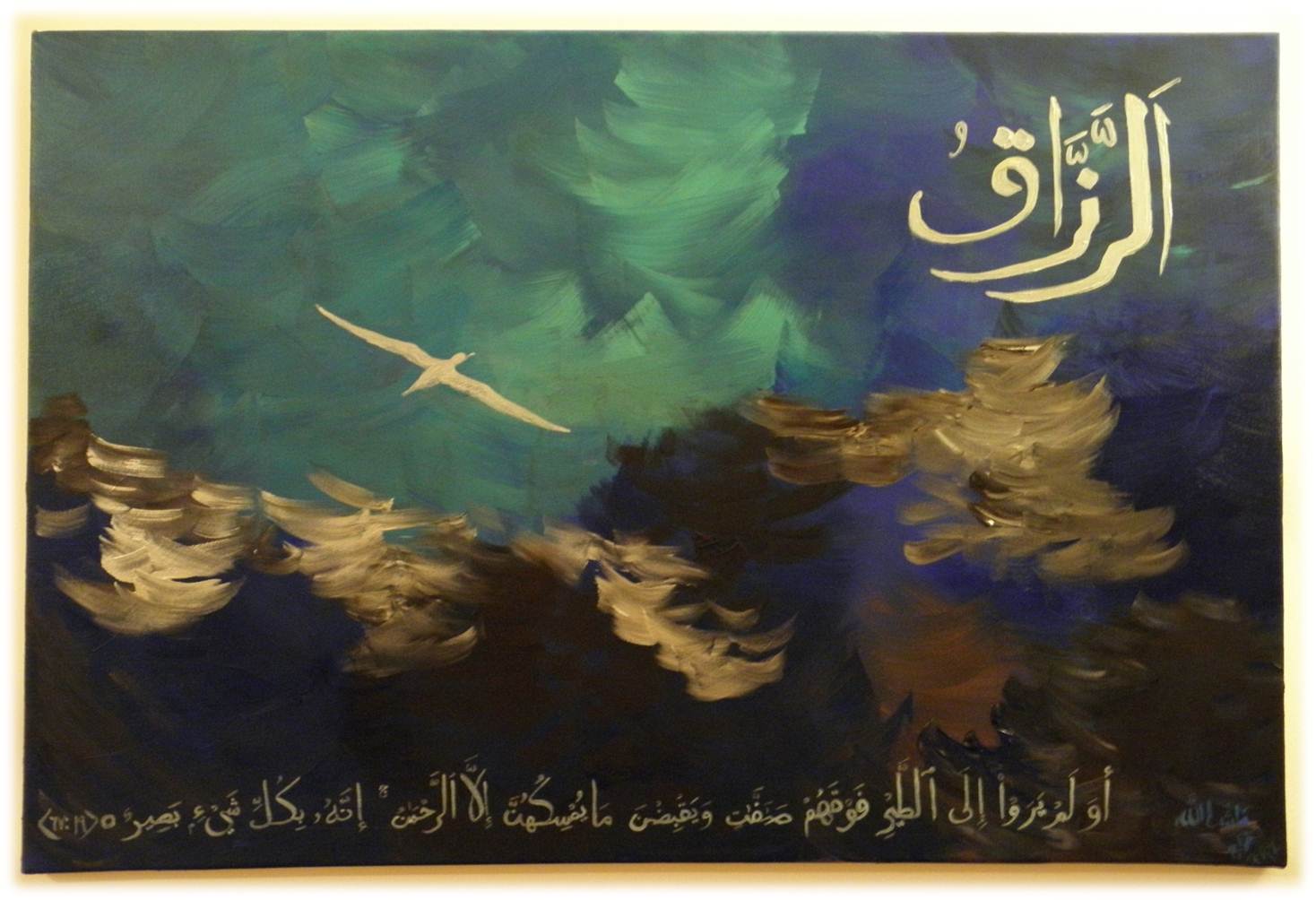
MashaAllah (by God’s grace) almost a year since I began it, today I finished a painting that is rather special to me. After days and days of carefully controlled hours with not much free time, finally today it was a day of nothing scheduled to do and therefore the luxury of being able to paint. This piece is special because I began it at a time I needed to be reminded that God indeed is in control of everything. It was a time when much I had built my hopes on was falling apart around me, a lot of it due to my own wrong doing or that my own best efforts were not enough. I felt like a bird, adrift over an angry sea, trying to keep my wings held high and keep going without the waves washing over me, trying to ride the storm.
I was reminded of the Albatross, that amazing bird, the true master of the seas… a bird some say once airborne over the oceans does not come back to land for over a year if not many years. And I was reminded of one of the names of God, what we Muslims call the ‘asma-ul-husna’ (the names of beauty or goodness). We say God has 99 names. Actually what is meant by names is more like ‘attribute’. For each of the attributes, God is the ultimate, the absolute sense of it. For example, one of the names is ‘al-wadud’ which means ‘The Love’. So God is THE love, all love come from Him, His love is the purest and truest sense of love. One of the things I love the most about the Asma-ul Husna, is that half are considered names of ‘Majesty’ or ‘Jalal’ and the other half are names of ‘Beauty’ or ‘Jamal’. You can see the first half are essentially masculine in quality and the second half are essentially feminine in quality. To illustrate, ‘Al-Lateef’ meaning ‘The Subtle or near’ would be a name of Jamal (beauty = feminine) while ‘Al-Jabbar’ meaning ‘The Compeller’ would be a name of Jalal (majesty= masculine). Without going in to too much detail, let me end by saying that many Muslims have these 99 names memorized and sing them or chant them as a form of worship or remembrance. We say we must try to live our lives embodying as many of these names as we can and in the best way, not many of us can do all, but it is a good to pick a few we want to focus on building in to our character and manifest that 🙂

The name I was reminded of during my time of difficulty is ‘ar-Razzaq’ meaning ‘The Provider’ or ‘The Sustainer’. We say all provision is from Allah. Indeed it is true, for we cannot create energy. All that we need and we take is already made. The source is the One. And on the less metaphysical but more everyday sense, we say every animal and tree has it’s provision assigned by God. Same for us, whatever we need, has been assigned. There is a beautiful article on this majestic name here. Do read it, It is much more descriptive than I can manage.

So the painting is about that. That for every bird out there in the ocean, each albatross on its solitary journey for miles and miles and months and months, ar-Razzaq, The Provider, is watching over and will sustain and nourish as needed. This reminded me of a beautiful ayah (verse) in the Quran, which mashaAllah I put at the end of the painting. It is ayah 19 of one chapter 67. A chapter that is considered to have many healing properties in its recitation.

أَوَلَمْ يَرَوْا إِلَى الطَّيْرِ فَوْقَهُمْ صَافَّاتٍ وَيَقْبِضْنَ ۚ مَا يُمْسِكُهُنَّ إِلَّا الرَّحْمَٰنُ ۚ إِنَّهُ بِكُلِّ شَيْءٍ بَصِيرٌ
Yusuf Ali Interpretation
Do they not observe the birds above them, spreading their wings and folding them in? None can uphold them except (Allah) Most Gracious: Truly (Allah) Most Gracious: Truly it is He that watches over all things.
Quran (67:19)

I will end with a link of a version of the recitation of the 99 names so you can listen to what it sounds like. And to end as always, to acknowledge that any good in me is from God and God alone.

Peace to all!